Madagascar
Product ID: 55570670
Desertcart purchases this item on your behalf and handles shipping, customs, and support to KSA.
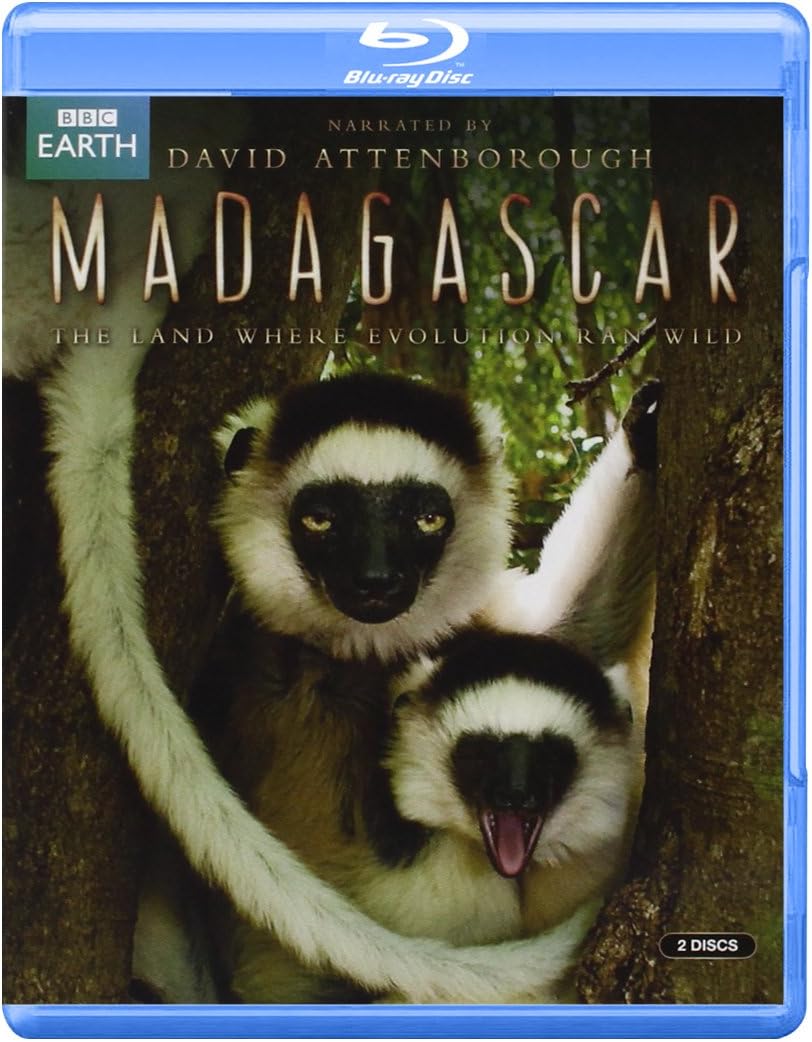
Lying just off the coast of Africa, Madagascar is a land of misty mountains, tropical rainforests and spiny desert scrub – and home to strange wildlife, most of which is found nowhere else on earth. Madagascar explores this extraordinary wildlife and the dramatic landscapes of one of the world's most bizarre islands. Using the latest in filming technology, the BBC's Natural History Unit captures the diverse and rare wildlife that inhabits this incredible land, some filmed for the first time, and features surprising stories of the favourite and enduring symbol of the island, lemurs, as well as less familiar creatures. There are frogs that turn from brown to bright yellow; wasps that pluck tadpoles from tree-nests; fish that swim upside down and the romantic life of the world's tiniest chameleon. Narrated by David Attenborough, Madagascar is the BBC's ambitious and intimate portrait of a fascinating but perilously fragile island. Special Features Review: A series of beautiful wildlife filming that leaves the bonus films to underline the human threat of extinction to that wildlife - This is another typical high quality product both written and narrated by David Attenborough. The recording itself is an HD product, copyrighted in 2011. The full value of the two discs really becomes apparent when the wildlife of Madagascar as shown in the main three films is compared with the reality of the effect of human activity. This is shown and described in the two bonus features which make it clear how fragile this very small remaining part of Madagascar is. The series consists of three 60 minute programs – Island of Marvels; Lost Worlds; Heat and Dust. A general outline is given at the start of this sequence as can be summarised as follows: Madagascar is both the oldest and the largest of the world’s islands and measures some 1000 miles in length – more than the UK for example. There is a chain of mountains running down its spine and these create a rain shadow where the east is more lush with good rainfall and the west is a land where drought lasts for 8 months of an average year. The far south is the most parched land and the far north is a land of slumbering volcanoes. The centre is prone to earthquakes. 80% of the wildlife is unique to Madagascar. The most populous animals are the many forms of lemur ranging from large to extremely small and some being nocturnal. Bearing in mind the threat of extinction hanging over much of the life of Madagascar it is perhaps appropriate that ‘lemur’ means ‘spirits of the dead.’ Other animals encountered in this informative series are the wide range of chameleons, an animal resembling a hedgehog that has up to 32 babies at a time, many geckos all of which have eyesight 350 times more sensitive than humans’ and thus enable them to see in full colour at night. We are also introduced to various insects and birds unique the island as well as to some snakes, none of which are poisonous. Throughout the three main feature films there is little to make the viewer aware of the massive deforestation that has removed 80% of the essential habitat of highly specialised creatures. The photography is unfailingly of the highest quality but avoids showing the wider context which would make the issue of habitat destruction obvious. As it is it is invisible and only referred to in a couple of summary sentences at the end of the third and final episode. However ………. The well-chosen bonus feature films tell a different story. There are two significant ‘extra’ feature films, both concerning Madagascar seen in a more fragile and threatened light than that of the main series. For these reasons they carry greater dramatic impact than the main features, superb though they may be. Indeed, the very fact of the main series’ superb photographic imagery hides the very real and present threat to the nature, of all sorts including plant life that the series does so much to present in all its implied glory. The first bonus film of 39 minutes and copyrighted in 2006 is presented by Charlotte Uhlenbroek with affection and concern. This concentrates on the struggle of a troop of Ring-tailed lemurs to survive in a forest area seriously damaged by prolonged draught, a recent cyclone and local deforestation. These conspire to create starvation for these animals which are shown to be very thin and with poor fur quality. It also becomes clear that the forest that we see in the main series is little more than the land of a small farm. It is estimated that 80% of the original forest has now been destroyed for farming and timber sales with likely catastrophic results for the indigenous wildlife. The second ‘bonus’ feature is the 2011 film, The Giant Egg, made by Attenborough in which he compares film he made 50 years ago with the current state of the island. He explores the extinction of the bird that probably laid the egg as well as a giant lemur weighing about half a ton. In addition to the issues raised by the previous bonus film this one ranges far more widely across the island where the natural vegetation that has enabled so much unique life to evolve has largely been destroyed by human activity. Madagascar’s mineral wealth is also been exploited with further destruction of the wildlife’s habitat. The recent initiatives favouring non-destructive activities, such as silk farming and replanting of a forest area, are promoted as encouraging signs but these seem pitifully small compared to the scale of the problem and the timescales involved – twenty years for planted trees to grow to a useful proportion for example. In summary, this series coupled with the two bonus films does far more than show attractive images of an attractive area. It explores Madagascar in the context of its history and future and poses crucial issues of survival for all non-human life. It is clear that, tragically, this unique example of evolution is close to extinction specifically brought about by human activity. In summary this is a series of beautiful wildlife filming that leaves the bonus films to explain and underline the human threat of extinction to that wildlife. Review: Stands up against Sir David's best work comfortably - As with all David Attenborough programmes you know his name is a mark of quality and in this three-part, three hour documentary from 2011 concentrating on the wildlife unique to the the island, located in the Indian Ocean off Africa and the 4th largest island in the world at nearly 1,000 miles long. 80% of the animals on this island have developed in isolation from the rest of the world, even some of the birds, and therefore these species are worthy of their own series on that basis alone. It isn't just the animals, such as lemurs that are unique however as the flora and fauna have developed in splendid isolation too. This then is a Darwinist's dream, much like Galapagos which Attenborough went on to cover in 2013. Many of the animals featured here are filmed for the first time ever with a production that took 18 months to put together. Filmed in glorious HD that really does justice to the format the sheer variety of rare creatures on display coupled with Attenborough's always enthralling commentary means your eyes rarely venture from the screen. The sheer size of the island means that there are different climates at each point of the compass which show the wonder of nature and how it adapts to circumstances via evolution. Of course Attenborough has been to the island before and historic footage from his very first expedition in 1954 captured in his first series 'Zoo Quest' occasionally appears to demonstrate both the differences in available technology and the fragility of the ecosystem due to man's increasing encroachment is considered effectively in counterpoint by Attenborough, ever the committed environmentalist. It's hard to find fault with any production fronted by the wonderful Sir David and this one stands up as an excellent exploration of one unique ecosystem. As someone who religiously collects his landmark series this is one which stands up against his best work comfortably.
| Contributor | David Attenborough |
| Customer Reviews | 4.6 out of 5 stars 531 Reviews |
| Format | Blu-ray |
| Genre | Music Video & Concert, Music Video & Concerts, Rock |
| Language | English |
| Manufacturer | 2entertain |
| Number of discs | 2 |
| Publication date | 7 Mar. 2011 |
| Runtime | 2 hours and 54 minutes |
I**S
A series of beautiful wildlife filming that leaves the bonus films to underline the human threat of extinction to that wildlife
This is another typical high quality product both written and narrated by David Attenborough. The recording itself is an HD product, copyrighted in 2011. The full value of the two discs really becomes apparent when the wildlife of Madagascar as shown in the main three films is compared with the reality of the effect of human activity. This is shown and described in the two bonus features which make it clear how fragile this very small remaining part of Madagascar is. The series consists of three 60 minute programs – Island of Marvels; Lost Worlds; Heat and Dust. A general outline is given at the start of this sequence as can be summarised as follows: Madagascar is both the oldest and the largest of the world’s islands and measures some 1000 miles in length – more than the UK for example. There is a chain of mountains running down its spine and these create a rain shadow where the east is more lush with good rainfall and the west is a land where drought lasts for 8 months of an average year. The far south is the most parched land and the far north is a land of slumbering volcanoes. The centre is prone to earthquakes. 80% of the wildlife is unique to Madagascar. The most populous animals are the many forms of lemur ranging from large to extremely small and some being nocturnal. Bearing in mind the threat of extinction hanging over much of the life of Madagascar it is perhaps appropriate that ‘lemur’ means ‘spirits of the dead.’ Other animals encountered in this informative series are the wide range of chameleons, an animal resembling a hedgehog that has up to 32 babies at a time, many geckos all of which have eyesight 350 times more sensitive than humans’ and thus enable them to see in full colour at night. We are also introduced to various insects and birds unique the island as well as to some snakes, none of which are poisonous. Throughout the three main feature films there is little to make the viewer aware of the massive deforestation that has removed 80% of the essential habitat of highly specialised creatures. The photography is unfailingly of the highest quality but avoids showing the wider context which would make the issue of habitat destruction obvious. As it is it is invisible and only referred to in a couple of summary sentences at the end of the third and final episode. However ………. The well-chosen bonus feature films tell a different story. There are two significant ‘extra’ feature films, both concerning Madagascar seen in a more fragile and threatened light than that of the main series. For these reasons they carry greater dramatic impact than the main features, superb though they may be. Indeed, the very fact of the main series’ superb photographic imagery hides the very real and present threat to the nature, of all sorts including plant life that the series does so much to present in all its implied glory. The first bonus film of 39 minutes and copyrighted in 2006 is presented by Charlotte Uhlenbroek with affection and concern. This concentrates on the struggle of a troop of Ring-tailed lemurs to survive in a forest area seriously damaged by prolonged draught, a recent cyclone and local deforestation. These conspire to create starvation for these animals which are shown to be very thin and with poor fur quality. It also becomes clear that the forest that we see in the main series is little more than the land of a small farm. It is estimated that 80% of the original forest has now been destroyed for farming and timber sales with likely catastrophic results for the indigenous wildlife. The second ‘bonus’ feature is the 2011 film, The Giant Egg, made by Attenborough in which he compares film he made 50 years ago with the current state of the island. He explores the extinction of the bird that probably laid the egg as well as a giant lemur weighing about half a ton. In addition to the issues raised by the previous bonus film this one ranges far more widely across the island where the natural vegetation that has enabled so much unique life to evolve has largely been destroyed by human activity. Madagascar’s mineral wealth is also been exploited with further destruction of the wildlife’s habitat. The recent initiatives favouring non-destructive activities, such as silk farming and replanting of a forest area, are promoted as encouraging signs but these seem pitifully small compared to the scale of the problem and the timescales involved – twenty years for planted trees to grow to a useful proportion for example. In summary, this series coupled with the two bonus films does far more than show attractive images of an attractive area. It explores Madagascar in the context of its history and future and poses crucial issues of survival for all non-human life. It is clear that, tragically, this unique example of evolution is close to extinction specifically brought about by human activity. In summary this is a series of beautiful wildlife filming that leaves the bonus films to explain and underline the human threat of extinction to that wildlife.
D**F
Stands up against Sir David's best work comfortably
As with all David Attenborough programmes you know his name is a mark of quality and in this three-part, three hour documentary from 2011 concentrating on the wildlife unique to the the island, located in the Indian Ocean off Africa and the 4th largest island in the world at nearly 1,000 miles long. 80% of the animals on this island have developed in isolation from the rest of the world, even some of the birds, and therefore these species are worthy of their own series on that basis alone. It isn't just the animals, such as lemurs that are unique however as the flora and fauna have developed in splendid isolation too. This then is a Darwinist's dream, much like Galapagos which Attenborough went on to cover in 2013. Many of the animals featured here are filmed for the first time ever with a production that took 18 months to put together. Filmed in glorious HD that really does justice to the format the sheer variety of rare creatures on display coupled with Attenborough's always enthralling commentary means your eyes rarely venture from the screen. The sheer size of the island means that there are different climates at each point of the compass which show the wonder of nature and how it adapts to circumstances via evolution. Of course Attenborough has been to the island before and historic footage from his very first expedition in 1954 captured in his first series 'Zoo Quest' occasionally appears to demonstrate both the differences in available technology and the fragility of the ecosystem due to man's increasing encroachment is considered effectively in counterpoint by Attenborough, ever the committed environmentalist. It's hard to find fault with any production fronted by the wonderful Sir David and this one stands up as an excellent exploration of one unique ecosystem. As someone who religiously collects his landmark series this is one which stands up against his best work comfortably.
L**T
Stunning
Firstly it's narrated by David Attenborough so do we really need to comment on what to expect. I must admit to being an avid fan of his and as a child remember glued to the broadcasts in the 1970's of Mr Attenboroughs shows. To this day i am never surprised when I watch a new series as I just know it's going to be awe inspiring. This Madagascar is no different. The photography is pure excellence and yes it does have a lot of Lemurs as someone added. The setting is magical and only missing King Julien (KIDS Version). A brilliant blu ray and stunning. Lemurs, Spiders are in abundance and so well photographed. The commentary is nothing but brilliant. Just love it.
G**A
Sir David is on top form, as always
This natural history documentary gives an excellent overview of the very specialised and different fauna and flora of Madagascar and the markedly different ecosystems within this huge island, It combines some early black and white film footage from David Attenborough's early Zoo Quest trip to Madagascar. The special feature on the Giant Egg is of particular interest. The other one, on the Ring tailed Lemurs, is a bit gushy. It would have been good to have a bit more science in that, with the commentator's views supported by someone able to give a more objective overview of lemur population changes and dynamics in this small Reserve.There have been relatively long-term observations and records in this Reserve and there is also a very obvious impact from tourism. It would have been interesting to have had more than just the usual comments on the limited habitat the lemurs occupy and resulting threats to them.
W**O
Natural History of Madagascar
This wonderfully filmed 2 disc 2011 documentary is produced by the BBC and narrated by the incomparable David Attenborough concerns the many unique animals and plants of the island separated from mainland Africa for a long geologic period which has enabled a diverse ecosystem to develop. This is now of course subject to human activities usually in the form of population growth and economic activity that follows, which has resulted in the decline of many species as the original habitants are eroded and at sometime will be below that need for a sustainable population which will result in that species extinction. Two interesting programmes make up the bonus features.
B**G
It is Region FREE, Just not Sony FREE
Thanks for the review by Mark Twain and the comment by Sanjay, I now know why Madagascar will not work on my 2 Sony BR players. I also took my copy of Madagascar to Best Buy and it did played on 2 other brands of BR players. I emailed Sony and then called their customer service and after some research; this is what Sony told me: Region FREE is for the European and Region Zero and 1 are for North America, and Sony is not prepared to do anything about it because it is a Region Code thing. There is no software upgrade available. I guess that Sony just did not included Region FREE into their software initially. I gave Madagascar a 5 star rating because I know it is a wonderful product. Not being able to play is just unfortunate that I (we) have Sony players. I do not want to down grade the product. I will advise Amazon UK about the situation and hope they will post a warning to US customers who owns Sony BR players. I have other UK BRs, and Madagascar happened to be the first one not playable. UPDATE: Sept 25, 2012 I had just upgraded to 3D TV. I purchased the LG 55LM7600 with the LG BD620 3D player. I watched Madagascar on simulated 3D and it was a pleasant experience. The five star rating for Madagascar now stands solid. The note Amazon UK placed just under the Madagascar title explains clearly why the Sony players will not play Madagascar. What Sony told me is just a brush off.
G**N
Excellent
Having seen most of these on TV, but missed a couple of episodes, I resolved to get the set. I was not disappointed, and I really enjoyed it. Very interesting info about the extinct elephant bird- it is amazing what info can be obtained now through tests and advanced scientific knowledge. One thing that does come through is how much David Attenborough loves animals, and how much he cares about the environment which the animals live in. This is one of the things that make him such a good naturalist!
L**T
Bittersweet
As someone who has been to Madagascar, albeit briefly, I can appreciate how fragile and beautiful this country is. This DVD was both a haunting reminder, and a poignant glimpse at what we could lose - within my lifetime. To my relief, the documentary was not doom and gloom and not forcing home the point of how fractured these pockets of magnificant wildlife are, but was instead a beautiful tribute. So beautiful, that it brought a tear to my eye, but also made me laugh.
Trustpilot
1 week ago
1 month ago