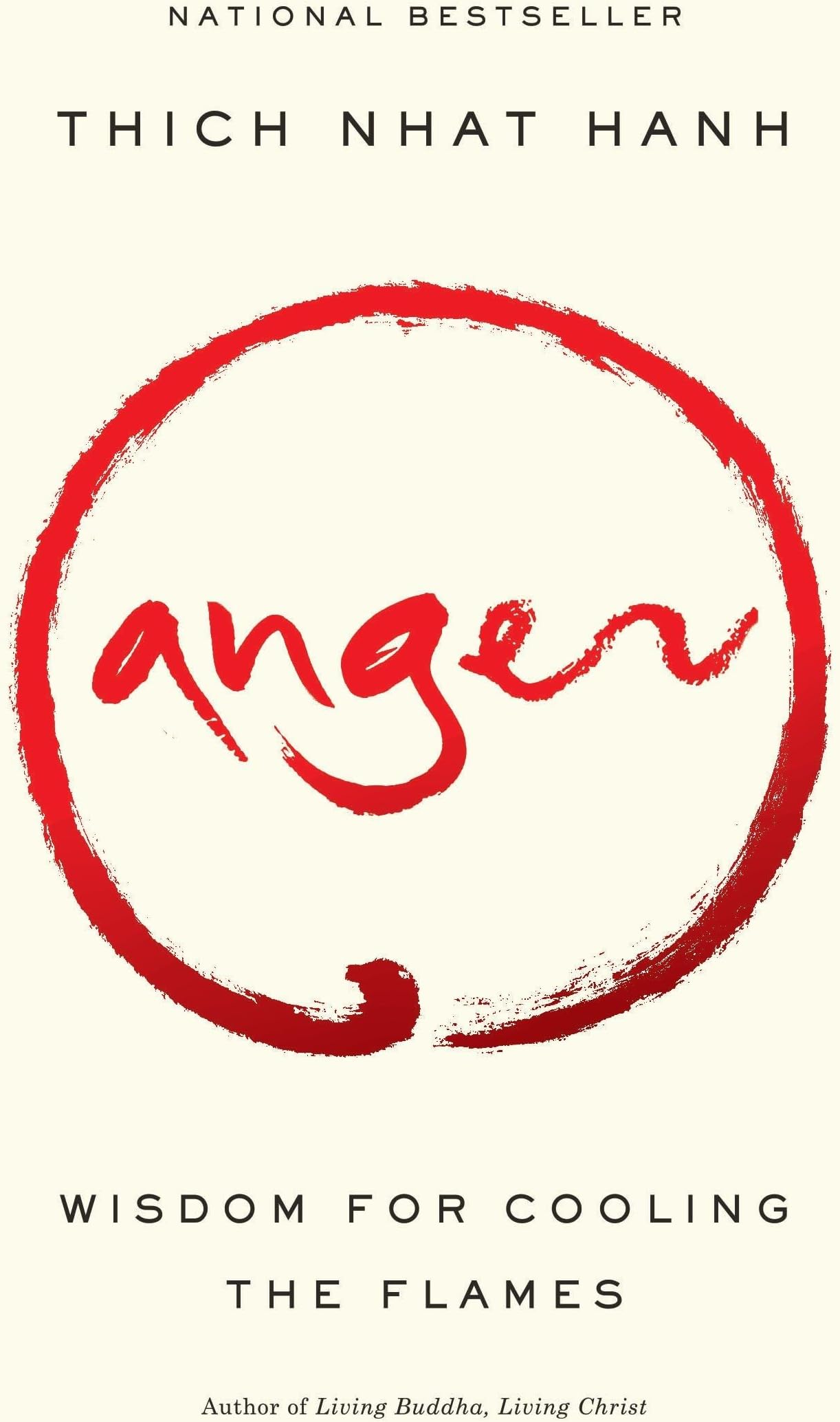
Anger: Wisdom for Cooling the Flames
Product ID: 503987
🌍Global peace insights from a Nobel nominee
🏆Top 10 in Anger Management Self-Help
📘240 pages of transformative wisdom
Desertcart purchases this item on your behalf and handles shipping, customs, and support to KSA.
🔥 Cool your inner fire, ignite your calm 🧘♂️
‘Anger: Wisdom for Cooling the Flames’ by Thich Nhat Hanh is a bestselling, 240-page guide blending Buddhist mindfulness with practical advice to help professionals transform anger into compassion and peace. Highly rated and globally recognized, this accessible book offers tools to improve emotional intelligence, relationships, and personal well-being.
| Best Sellers Rank | #14,668 in Books ( See Top 100 in Books ) #4 in Dalai Lama #10 in Anger Management Self Help #86 in Spiritual Self-Help (Books) |
| Customer Reviews | 4.6 4.6 out of 5 stars (2,863) |
| Dimensions | 4.6 x 0.64 x 8 inches |
| ISBN-10 | 1573229377 |
| ISBN-13 | 978-1573229371 |
| Item Weight | 2.31 pounds |
| Language | English |
| Print length | 240 pages |
| Publication date | September 3, 2002 |
| Publisher | Riverhead Books |
A**E
simple, profound, transformative (if you can let it in)
Anger: Wisdom for Cooling the Flames by Thich Nhat Hanh It’s hard to summarize the lessons I learned from the book of Anger by Buddhist monk Thich Naht Hanh, because there were so many. Much of it was like finding the words for things I already knew, subconsciously or not. Like the profound relief we gain when we feel heard. Or how we want to punish others when we suffer. (Why does this even make sense and yet is so horribly true?) One of the oft-repeated mantras in the book is about compassionate listening and loving-kindness speech. It seems obvious that listening with compassion is a good thing. But the fact that it can help the other person suffer less is not as apparent. If we can allow the other person to express herself and find relief from her suffering, then we have accomplished the one and only goal of compassionate listening. Of course, keeping compassion alive the entire time we listen is not easy, especially when we are implicated in the other’s suffering. The desire to defend oneself, or to criticize the mode of expression is both deep and diabolical. Both those can instantly undermine any positive effects of compassionate listening. TNH suggests a practical if formal template for how to approach anger, both in ourselves and in others. The first step is admitting our anger. We can’t pretend that we don’t suffer: “In true love, there is no pride.” Second, we can’t claim we are doing our best unless we practice. And last, we have to let the other person in. “Darling, I suffer. I am angry. I want you to know it.” “Darling, I am doing my best. I am taking good care of my anger. For me and for you also. I don’t want to explode, to destroy myself and destroy you.” “Darling, I need your help. I cannot do this without you.” Of course, the success of this exchange depends on mindfulness, on mindful breathing, walking, sitting, speaking, listening. On digging deep to find the roots of our anger. On never saying or doing anything out of anger, but waiting until we are ready to listen compassionately and speak with loving-kindness. As TNH so wisely puts it, “If your house is on fire, the most urgent thing to do is to go back and try to put out the fire, not to run after the person you believe to be the arsonist.” I appreciated the reminder to wait until we were cooler headed, but even more so, I loved the entreaty to come back after 24 hours, or even by next Friday. In the meantime, we are to write a peace note to the other person. As someone who greatly suffers from the so-called silent treatment (and the subsequent ignoring of said conflict), I was relieved to know that there was another way to approach things. A dear friend calls it throwing the other person a lifeline. You tell them you’re upset and you need time to come back to it with love and good energy, but that you will. The Buddha himself says that a monk has the right to be angry, but not for more than one night. We can’t all be monks, so I’m willing to give it more than 24 hours, but I desperately need the coming back together in order to move on. This next seems a lesson I will keep learning my entire life: “We should not be sure of any perception we have.” According to TNH, anger mostly comes from incorrect perceptions. He says to write on a piece of paper, “Are you sure?” and hang it up in your room. And even if you are sure, check again. Anger is defined in the book as an energy, with seeds that may have been watered too frequently over the years. The counter-balance is to water the positive seeds in you—the seeds of love, compassion, and understanding. I’ve been practicing this a little by writing in a gratitude journal every night before I go to sleep. Any practice of positivity keeps us in touch with elements that don’t constantly express suffering: the trees, flowers, children, art—whatever is refreshing, healing, and nourishing. As TNH says, “Let your friends rescue you.” Along those lines, the book emphasizes that happiness and well-being are not individual matters. We are not separate from each other, from our parents, our ancestors, our friends. And not only that, our self is made of “non-self” elements, like the sun, the air, the earth, the food we eat. I love this psychedelic sense of connection, of selfhood as a universal - even cosmic – concept. One way to save yourself from being overwhelmed by anger is by writing a Heart Sutra. When you feel very grateful for the other person in your life, TNH says to withdraw and be alone and immersed in those feelings. Write them down as an act of gratitude, enlightenment, mindfulness, intelligence. This is your Heart Sutra, meant to be read in times of need. I also loved the idea of gift giving as a way to transform your feelings of hurt and anger at someone into wanting to make them happy. TNH advises not waiting until you’re angry to buy a present. He says to buy it when you feel the love. Have the luxury of two or three presents stashed secretly in your drawer, ready to be gifted. I haven’t done the advance buying yet, but I know that the general idea works. Doing something nice for someone, even (especially?) someone I’m mad at, invariably makes me feel better. Over and over, TNH reminds us that the energy of mindfulness is the key to transforming the energy of anger. Suppressing, fighting, or ignoring anger will do no good. It must be recognized and embraced, often with great tenderness, in order to be transformed: “Hello, my little anger, I know you are there. My old friend.” Far from reducing anger, punching a pillow (and acts like it) only rehearses it, trains you in aggression, strengthens and grows the seed of anger inside you. The danger of venting feels intuitively correct to me. I don’t want to project any semblance of violence, even on something as “forgiving” as a pillow. Our enemy isn’t the other person. Our enemy is the violence, ignorance, and injustice in us and in the other person. So we practice mindfulness to look deeply for the roots of our anger, to gain insight, which has the power to liberate us and allow transformation. In the end, our emotions are just that. Emotions. And this might be the hardest lesson of all. We are more than our anger, more than our suffering, more than our emotions. All storms pass, and we have to remember that, and have hope. And in order to take care of our emotions, we have to go back to the body. We lie down, and we breathe: “Breathing in, I calm my whole body, breathing out, I calm my whole body.” It doesn’t matter how intelligent we are, how much knowledge we’ve gained, how young or old or alone or stuck. Changing our habit energy (and we all have it) requires practice. We don’t have to wait for anyone else in order to start practicing. Transforming ourselves makes reconciliation possible, no matter how resistant the other person is. And either way, we are making space for compassion, for connection, for calm, for love, for kindness, one mindful step at a time.
K**T
An excellent book on anger and how to deal with it
This book is great for many reasons: For one, it gives the Buddhist philosophy with hardly any dogma or dry, hard to understand Buddhist teachings. He keeps it simple and in plain English he explains the concepts of how to approach life - and anger - in a Buddhist manner, which is much simpler and user friendly than you would imagine. One need not "be a Buddhist" to read this book or benefit from it. In fact, it is more of a self-help book, that just happens to be written from the perspective of a Buddhist monk. He gives you practical and easy to practice advice about how to deal with your wife or husband when you are boiling with anger. And at the same time he explains how just sitting quietly with your breath, or being mindful in your daily actions, can help you to overcome your anger. And when the anger arises anyway, he tells us not to get mad about getting mad, but rather to accept it, lovingly, and treat your anger as a crying baby, that you must accept it and soothe it. One does not cut one's stomach out when it has indigestion. By the same token, one should not cut one's anger out, but rather learn to quiet and calm it. I'm just paraphrasing, but that's more or less the lesson as I understood it. But there are many more lessons here, and the book is written in such a simple, easy to understand way. I'm used to reading books that are written in a more complicated style, for example some of the Buddha's teachings translated from the original Pali, which require a little more work to understand. Or even some of Hanh's other books, such as The Heart of the Buddha's Teachings, which, though not difficult to understand, are a little more complex. But this book is so easy to read and so easy to understand, I am giving it to my wife as an introduction to Buddhism, (she is Catholic), so that she can see in a very clear and easy way what Buddhism is all about. Also I am asking her to read it, as a way of showing her that I am working on my anger, and enlisting her help by showing her the approach I am taking, via this book, and asking her to help keep me mindful of my anger and mindful in general, and skillful in dealing with my emotions. I have looked at dozens of Hanh's books, and while they are all worthwhile, this one is perhaps the most clear and easy to understand, basically distilling Buddhism down to its essence of mindfulness, and compassion, and watching the breath. This book, I think, is especially helpful for anyone who has anger issues and who wants to reduce the suffering in his or her life, not only for his or herself, but also for his or her loved ones, whether it be one's daughter, son, wife, husband, mother, father, or etc...
M**T
great read!
Loved it! Very succinct and helpful! I loved his advice for how to be calm and how to forgive others.
J**A
Always A Good Read
This may be just another Thich Nhat Hanh book, but like so many of his others, it’s easy to read, encouraging, insightful, uplifting and so much more. I think everyone could benefit from reading this book. Especially in this day and age.
N**O
Great Book
I’ve read this book 5 or 6 times. It’s just that good. He really helps you understand your own anger and how to handle it.
P**W
Gently used book
Received in good condition in a timely manner. Pleased with my purchase
L**T
Priceless Perspective on Anger
We live in an angry world these days—road rage, wars, abuse and exploitation, media manipulation. Anger is driving people to all kinds of violence against others and against themselves. Thich Nhat Hanh gives us new perspectives on where anger comes from, how to handle it, and how to keep it from handling us.
M**S
Insightful
Thich nhat hanh delivers concepts in such a beautiful way. He also adds many stories and examples when he is writing. Something I’m taking away from this book is to care for my anger as a mother does her baby.
A**E
Dirty book
Dirty book
D**A
Looks a fake copy of the actual book.
Just received this book....but it looks like a cheap copy. The pages have not even been cut evenly !! Never thought Amazon would induöge in selling such bad quality.
A**R
this book actually works for me. It brings me ...
this book actually works for me. It brings me a lot of self awareness and brings me peace of mind. Even my partner has noticed a change!
H**D
Excellent Book by One of the Wisest Human Beings on the Planet
Hanh is a Buddhist master, and after reading this book it is easy to see why. One of this book's central messages is that anger, despite what we might think, comes from within, not without. Life is ceaselessly changing and often disappoints us, but it is how we react and our thoughts about it that control whether we give in to anger or accept change and disappointment as a part of existence. Hanh presents in a clear and concise way how to overcome anger towards human beings and life's disappointments. The best message I got from this book is that anger, regardless of where it comes from, is an ultimately negative emotion that just creates more anger. When we learn to stop ourselves from getting angry, we are benefiting both ourselves and those around us. When you add to this the numerous studies that now show how anger and stress affect our physical health, there is even more reason to accept this book's teachings. I had an interesting chance to test this book's effectiveness right after I finished it. Two days later my car broke down and my fiancée and I were hit with a $1000 repair bill. Normally I would've been extremely upset and angry, but I took it completely in stride, got the car fixed, and moved on. It was as if a new me had come along and replaced the old one. My fiancée says she's noticed a big difference in me since I read this and started really trying to live its teachings. I certainly still have my slip-ups, but my anger never reaches the peaks it did before. I was never a person with anger management issues, but it wasn't until I read this that I realized how much energy I had been channeling into negative thoughts and emotions that served no purpose and only made adversity worse. This book will teach you how to deal with anger in every situation, whether it's a broken down vehicle or a confrontation with your worst enemy. I never read "self-help" books because most are bunk; I only picked this up because I like reading about Buddhism and noticed the author was a Buddhist master whose named I recognized. That was a fortuitous occurrence, because it allowed me to pick up and read a book which has had an extremely positive effect on my life ever since. The best part is, the whole book can be finished in a day or two. Living its teachings in the long-term is up to you, but you owe it to yourself and your loved ones to read this and learn from its infinite wisdom.
S**A
怒り
我々は、日常的な小さな事から、政治・世界情勢に絡む大きな事まで様々なことに怒りを憶える。 怒りに身を任せ破滅への道を歩まず、いかに怒りを消化・昇華し平和への礎にするか。 是非ご一読下さい。
Trustpilot
1 month ago
2 months ago