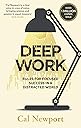
Deep Work: Rules for Focused Success in a Distracted World
Product ID: 48734977
🌐English language - global accessibility
📅2016 publication - timeless relevance
📖304 pages - deep, actionable insights
Desertcart purchases this item on your behalf and handles shipping, customs, and support to KSA.
🚀 Elevate your focus, dominate your day, and leave distractions behind!
Deep Work by Cal Newport is a 2016 bestseller offering 304 pages of actionable advice on mastering focused success in a world full of distractions. Combining cultural critique with practical rules, it empowers professionals to boost productivity, creativity, and fulfillment by cultivating deep, undistracted work habits.


| Best Sellers Rank | 2,408 in Stationery & Office Supplies ( See Top 100 in Stationery & Office Supplies ) 4 in Reading & Writing Curriculum Resources |
| Customer Reviews | 4.5 out of 5 stars 35,822 Reviews |
N**A
Excellent
Read this a while ago but posting the review only now. I use the learnings from this book even now! So elementary and yet so useful! Well done.
B**N
A much needed work in an age of distraction and instant gratification.
At its core, Newport’s thesis is simple: in the (current) knowledge economy, where a person’s creativity – of which something machines are incapable – is his/her greatest asset, the need to focus and concentrated (what Newport calls ‘Deep Work’) is what enables that person to produce real value. This is especially pertinent in a time dominated by instant gratification and endless distractions, where we often value speed over quality, efficiency over effectiveness. Newport’s book is divided into two parts: the first builds his case for why Deep Work is important; the second consists of various ‘rules’ to implement Deep Work into one’s life. The book is a good read – neither unnecessarily technical, nor just fluff and a collection of internet wisdom. He cites many examples which help concretise his suggested approaches. I found the book particularly helpful because he has a well-thought-out structure. The book’s flow is good as well. It is extremely practical and as I read it, I found myself evaluating how I used my time. It won’t be easy implementing everything he suggests in the book (and it might not work for everyone), but I think the core issues he covers are solid. My work and personal lives have benefited from reading this book. I’ve become a bit more disciplined and careful with how I use my time. It’s a process of two steps forward, one step back but I can already see progress. Another positive is Newport’s assessment of our current society’s relationship to distractions. He helped me to review habits in my life that weren’t good. I also started to listen to Fast Company’s ‘Secrets of the Most Productive People’ podcast which helped to consolidate the lessons I learned from this book.
H**.
A very important book
I really resonated with this book. I work in software, and even though my job requires a lot of hard thinking and problem solving, I find myself constantly distracted by a work culture which seems to think it's ok to be perpetually interrupted. This book has been my guiding light and adopting even half of what it recommends is challenging, but very worthwhile. If you read "So Good They Can't Ignore You" you might remember Cal Newport highlights the need to develop "career capital", that is, hard-earned rare and valuable skills, which enable you to get a meaningful / satisfying job. This book is a substantial part of the answer to the question of: "how do I get rare and valuable skills?". Newport starts the book by arguing quite convincingly that deep work is not only increasingly rare, but increasingly valuable. But let's rewind a bit, what is "deep" work? Deep work is defined as working in a very focused manner, free from distractions, intensely concentrating on something that hopefully yields a valuable outcome. The output need not be something physical, it could be an insight, an idea, or a skill. Think of straining your brain to solve a puzzle versus copy and pasting things while chatting to a colleague. The former is deep, the latter shallow. Deep work is becoming increasingly rare because of our work culture's obsession with "connectivity", open plan offices, and social media. Why are we destroying our ability to work deeply then? Some things stand out, like the fact that it is hard to get metrics for how these things make us less productive, how hard it is to quantify the productivity of a knowledge worker, and how we tend to jump on the latest tech without thinking about alternatives / downsides. The case is made for deep work becoming increasingly valuable partly because of these distractions: if you can do it, you will stand out. But it's also valuable because of what it leads to: mastery of hard skills, and valuable output. Apart from these extrinsic benefits deep work is also intrinsically meaningful. It can cultivate a sense of craftsmanship and can lead to the fulfilling "flow" state. After the "what" and the "why" the rest of the book focuses on the "how". Lots of useful ideas and techniques are explored here. The general theme is do what you can and be thoughtful about how you spend your day. For example identify how you can do deep work: is it possible for you to go to the woods for the weekend, or (like most busy people with jobs) do you have some morning/evening time to use well? Make good routines / rituals. Schedule distractions and make focus your default state. Quit (or reduce your time on) social media. Adopt tech with a more critical mindset. Be less available on email etc. To conclude, this book is a shining light in the fog of modern work practices. If you are an attention deprived knowledge worker, it will likely help you a lot. But I can see it benefitting a wider class of people, because our ability to focus is so important.
L**R
An enjoyable read
An excellent book, taught me some new deep work focus and flow techniques. Well written and an enjoyable read
P**K
Focusing deeply on what matters
“Deep Work is the professional activities performed in a state of distraction-free concentration that push your cognitive capabilities to their limit. These efforts create new value, improve your skill, and are hard to replicate.” Cal Newport offers a very compelling argument as to the value of organising those periods when we all need to focus on the work/knowledge we need to obtain to further our professional goals and ambitions. Newport cites examples of key influential and high achieving individuals such as JK Rowling and Bill Gates where they each notoriously became obsessively focused when they needed to achieve the important deliverables or direction they needed in their professional goals. In a world where information is coming at us in greater variety, velocity and volume, we find ourselves unable to consume enough of or the right information, amidst all the noise. In a contrary way, as the information availability accelerates the less we effectively absorb as valuable and usable content. To be expert or at least highly capable in our work area, we need to build on strong learned foundations so we can deal with the inevitable problems with much more confidence and resourcefulness. I would be a strong advocate for subconscious processing of information, and deep though periods, as long as we can secure the undistracted downtime for it to be properly embedded into our thinking and rationalisation processes. Newport provides a framework for achieving this way of deep life, but it does require drastic changes to your lifestyle. This may not be for everyone and certainly seems to be more geared towards those in pursuit of academic accomplishment or specialised achievement. Newport does suggest that to live the life of Deep Work we need to put the distraction of social media aside so we can deploy our minds to its fullest capacity to create things that matter. While I accept that social media can consume considerable time that is of little value, there are many roles in today’s society and workplace that require constant engagement with customers, suppliers, colleagues and online audiences. Like many things in life, it’s all about balance and I would recommend the Deep Thought approach as part of a daily regime but not to the exclusion of all other interactions. It is difficult to account for every minute of the day and attribute it towards a valuable contribution and I can imagine this will lead to frustration rather than reconciliation.
B**8
Deep, but not deep enough
There are some interesting and engaging thoughts in here, but personally I did not find as much value in it as I hoped. A lot of the initial set up seems heavily anecdotal and relies on assumptions which did not chime with my own experience. The particular focus on the typical working patterns of a modern knowledge worker didn’t seem to offer much insight other than “you need time to concentrate” - which is a bit obvious. His dismissal of or disdain for everything internet based felt very shallow. Maybe this book is slightly showing its age, but in 2025 “the internet”, communication tools, social media and productivity tools are so interlinked it’s impossible to simply not be online. A more deeply researched piece of work would have covered the role of microdosing dopamine etc rather than just saying small internet based tasks are bad because they stop you doing longer pieces of work. On the whole I’m not defending social media - it’s pretty poisonous. It just felt like this book came at it from someone who doesn’t really understand how people interact with the online world.
O**T
Provocative
Very good book. Very clearly depicts how we tumble into shallow habits through being followers of tech fads as opposed to being discerning users. Lots of ideas and the basis/rationale behind them. Well researched and clearly written. An easy read that contains a number of “ aha” moments. I would have easily given this 5 stars on the basis of content but for one shortcoming: there is no summary of the various “rules” - and there are many “rules”. It would have been immensely helpful to have had a reference source in one place, drawing it all together. As a consequence, a lot of intriguing and useful ideas are dimmed, relegated to partial recall, and lost to those that followed. I will reread this book to take notes, but in his quest for depth, efficiency and productivity, I don’t think the author had that in mind....
P**O
Fanastic book, extremely refreshing given society's unhealthy obsessions with shallow social media
I found this book exceptionally useful. Having thoroughly enoyed Cal's first book 'So Good They Can't Ignore You', I was very interested to see how he followed it up with a big specifically focused on deep work and cultivating fantastic working habits. I think he's done a tremendous job in identifying the problems associated with the modern work place and how making a very deliberate effort to carve out time to engage in deep work can prove extremely beneficial to one's career and life satisfaction in general. There's a serious disincentive for me to write this review in many respects given that the more publicity the book gets, the more people may engage in deep work and the more competition there will be at the top! But in all seriousness, I think society's obsession with shallow social media is despairing and any efforts to try and move us away from a reliance on the addiction of checking facebook/twitter/instagram/snapchat/pinterest etc can only be a good thing. Cal rightly points out that these companies can provide very apparent benefits to the users. But just because catching up with an old friend on facebook once a year is beneficial, it does not mean that benefit outweighs hours and hours of useless scrolling through a newsfeed for mundane updates on past acquaintances' lives. Even more pernicious is the deleterious effect of craving the constant stimulation of an updated newsfeed on one's concentration. I absolutely relate to the need to constantly check e-mail and facebook when trying to accomplish something challening at work. It's not even that I feel concerned I have to respond to e-mails quickly, it is genuinely a desire to experience the rush of a notification, as sad as that may sound! Therefore Cal's book is a massive breath of fresh air and I'm very excited about the prospects of committing to a life of deep work. It will be immensely challenging I'm sure. But the rewards will undoubtedly be worth it.
A**V
Deep
A must read book for every aspiring and seasoned professional to take control of daily work flow.
I**.
ismaild
Kitabın çoook kısa bir özeti: Sıkıldığınız zaman öğrenmeye başlarsınız... Harika bir kitap
F**S
Calidad y versatilidad de contenido
Es un libro muy completo y realmente sirve para lo que es, si estás enfocado en una maestría o algún proyecto, pero no avanzas o no tienes resultados precisos, éste libro es idóneo para abrirnos la mente en qué estamos fallando. Por parte del vendedor no lo empacó debidamente y llegó con un ligero golpe, además unas manchas en la portada pero quizás sea de la imprenta.
O**A
Excellent book to improve productivity
Excellent book to improve productivity
J**9
Create a meaningful difference in your work
This is a well-considered, balanced and persuasive book with many insights. While the author is in the sciences, I recommend this book to anyone in the arts who is looking to nurture their creativity and production. This book provides a foundational concept for people who want to build a body of work that creates a meaningful difference. The idea is that we do our best (deep) work when we have the habits and conditions that support, encourage and build that capacity. It is not for everybody. If you want 'hacks' or shortcuts, this is not the book for you. This book goes beyond the "hustle and grind" approach of putting in time and effort - it presupposes that you're willing to do both of those things. It asks – what will differentiate you then? That is the core goal this book will help you with - to sustain creating and producing work that is the best quality you're capable of (or even better than you've been capable of in the past). Newport spends the first half of the book providing the research and context to back up the argument that deep, focussed work is what will generate these breakthroughs. The second half of the book steps through the how. Each of the four rules is given with guidance and ideas for implementation that refers to the examples and context given in the first half of the book. This book is not for everybody, that's okay, just consider your needs, your work/art. If you need time to think or plan or create before you do what you do, this book is aimed at you. I'm grateful to Cal Newport for this book. There are things I have already been able to use as I have made this first read through, and other aspects that will take me longer to try, and test for my own needs. It was absolutely worth reading.
Trustpilot
3 weeks ago
3 weeks ago