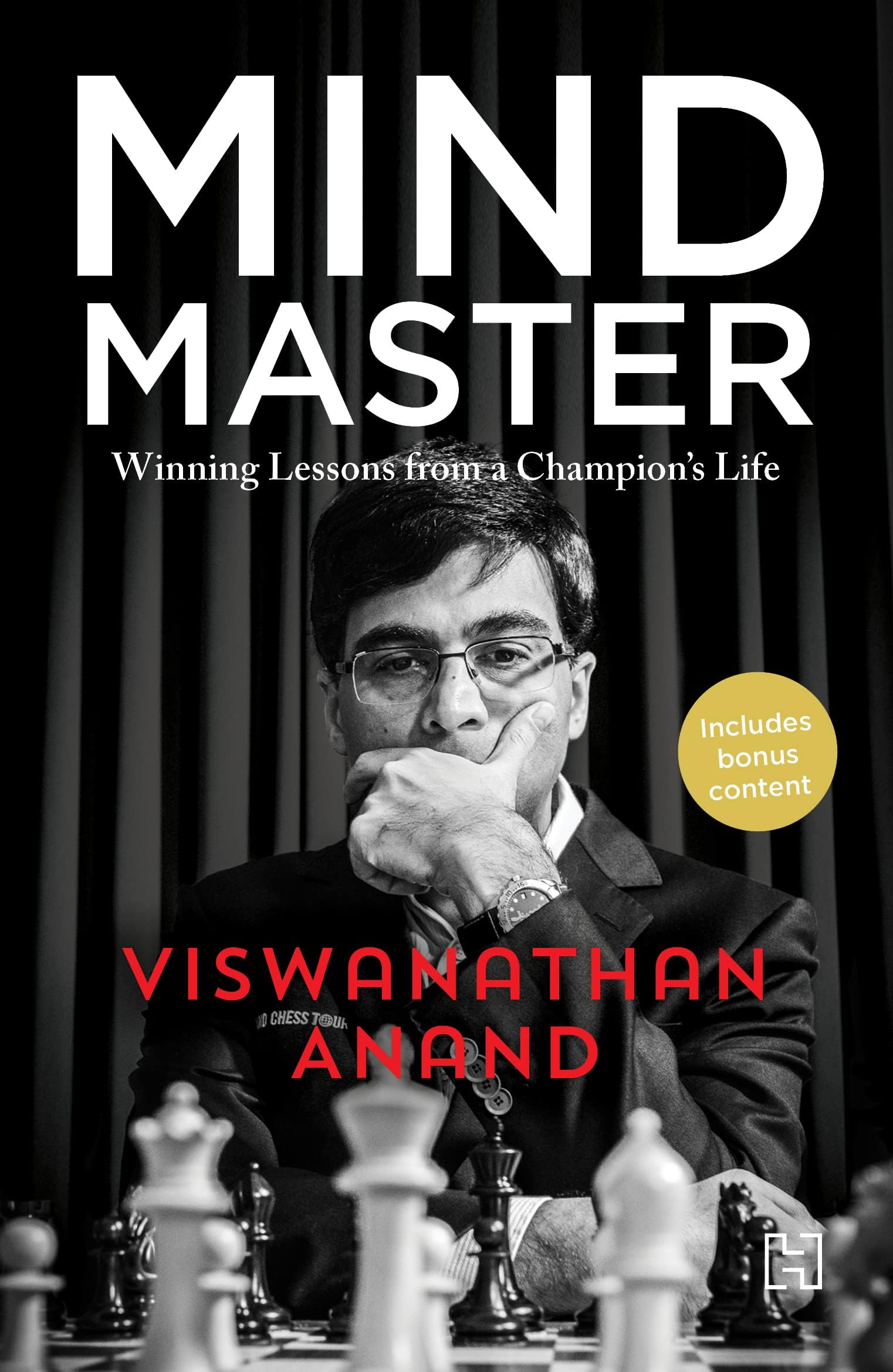
MIND MASTER
Product ID: 361588496
Desertcart purchases this item on your behalf and handles shipping, customs, and support to KSA.
From the Publisher Review: Excellent read - This book is about Vishwanathan Anand’s professional chess career, but it is also a lot more – a tribute to his entire support system, family and passion which goes into the making of a world champion, and has lessons for life itself. For Indians, Anand is a national icon – a champion (the first chess grandmaster from India) who represents the country where the game originated with great grace & passion. Often being a nice guy is not exactly good news, the media would much rather write about “temperamental”, “erratic”, “angry”, “arrogant” achievers. As a result, a lot of what Anand achieved was regarded as either being lucky or not enough (for a 5-time world champion!) and has been less written about. The book oscillates between multiple timelines but has coverage of Anand’s early years – the support from his mother, his gradual ascent to becoming a grandmaster and his professional career right till his loss to Magnus Carlsen in the World Championship. There is considerable coverage on the preparation for each of the big world championship tournaments and the contributions of his family (his wife and at times earlier his dad doubling up as his manager to negotiate contracts) & the support team, and the politics involved. This is perhaps one of the few books you will read where the ideas & efforts of the support team are acknowledged so graciously. The matches against Kasparov, Kramnik, Topalov, Gelfand & Carlsen all make for very interesting reading. There are also discussions around the growing role of technology. Anand mentions how many years back when Ken Thompson (designer of the original Unix operating system) was asked if computers could learn strategy – he answered without hesitation that it would happen without doubt as strategy was in simple terms “long term tactics”. Apparently, many chess players knew that machines would overtake them at some point, though they preferred not to go public with that. There is this interesting narration on the preparation for his match with Topalov. Anand’s team came to know that Topalov had access to the latest version of the Rybka chess engine running on 128 core hardware. Coincidentally, Anand received help from Kramnik & Kasparov and was able to prevail in a close match over Topalov. Anand admits that starting with his title defense against Gelfand, he has found it difficult to find new ideas and re-invent his game. He acknowledges how Magnus Carlsen was far better prepared – had new ideas and had thoroughly researched Anand’s style. This book is an excellent read. It could have been even better if it were better organized. The book in fact gets off to a very average start with the first paragraph being poorly written. But it recovers after that, and the overall content is top class. Anand has been an exceptional ambassador for the game and would be a great mentor and is an inspiration for the next generation of chess players. Strongly recommended – you only need a working knowledge of the game as there are very few game analyses included. Review: Best like Vishy Sir. - There is a reason, why this is one of the most selling book here. There are invaluable teachings, even though you are not chess player it is very easy to understand and relate too, as there is not a lot of chess related content. Then there are summaries or important excerpts of every chapter at last , really good book.


| Best Sellers Rank | #13,478 in Books ( See Top 100 in Books ) #3 in Physical Medicine & Rehabilitation #5 in Sporting Events & Organisations (Books) #24 in Sports Training & Coaching (Books) |
| Customer Reviews | 4.6 out of 5 stars 1,335 Reviews |
B**N
Excellent read
This book is about Vishwanathan Anand’s professional chess career, but it is also a lot more – a tribute to his entire support system, family and passion which goes into the making of a world champion, and has lessons for life itself. For Indians, Anand is a national icon – a champion (the first chess grandmaster from India) who represents the country where the game originated with great grace & passion. Often being a nice guy is not exactly good news, the media would much rather write about “temperamental”, “erratic”, “angry”, “arrogant” achievers. As a result, a lot of what Anand achieved was regarded as either being lucky or not enough (for a 5-time world champion!) and has been less written about. The book oscillates between multiple timelines but has coverage of Anand’s early years – the support from his mother, his gradual ascent to becoming a grandmaster and his professional career right till his loss to Magnus Carlsen in the World Championship. There is considerable coverage on the preparation for each of the big world championship tournaments and the contributions of his family (his wife and at times earlier his dad doubling up as his manager to negotiate contracts) & the support team, and the politics involved. This is perhaps one of the few books you will read where the ideas & efforts of the support team are acknowledged so graciously. The matches against Kasparov, Kramnik, Topalov, Gelfand & Carlsen all make for very interesting reading. There are also discussions around the growing role of technology. Anand mentions how many years back when Ken Thompson (designer of the original Unix operating system) was asked if computers could learn strategy – he answered without hesitation that it would happen without doubt as strategy was in simple terms “long term tactics”. Apparently, many chess players knew that machines would overtake them at some point, though they preferred not to go public with that. There is this interesting narration on the preparation for his match with Topalov. Anand’s team came to know that Topalov had access to the latest version of the Rybka chess engine running on 128 core hardware. Coincidentally, Anand received help from Kramnik & Kasparov and was able to prevail in a close match over Topalov. Anand admits that starting with his title defense against Gelfand, he has found it difficult to find new ideas and re-invent his game. He acknowledges how Magnus Carlsen was far better prepared – had new ideas and had thoroughly researched Anand’s style. This book is an excellent read. It could have been even better if it were better organized. The book in fact gets off to a very average start with the first paragraph being poorly written. But it recovers after that, and the overall content is top class. Anand has been an exceptional ambassador for the game and would be a great mentor and is an inspiration for the next generation of chess players. Strongly recommended – you only need a working knowledge of the game as there are very few game analyses included.
A**R
Best like Vishy Sir.
There is a reason, why this is one of the most selling book here. There are invaluable teachings, even though you are not chess player it is very easy to understand and relate too, as there is not a lot of chess related content. Then there are summaries or important excerpts of every chapter at last , really good book.
C**A
A good book for aspiring Anands of tomorrow
In Mind Master, India’s first GM “Vishy” (a misnomer given to him by the Europeans, for Viswanathan is his father’s name) Anand looks back at more than a quarter century of career playing chess at a professional level. Dubbed the “lightening kid” in his younger years for exceptional speed, Anand went on to win the World Chess Championship several times, not to mention many other awards and accolades along the way. The book gives the reader a close peek into the thinking, strategizing and planning that went into several of his crucial matches. What were the challenges that Anand faced? How did he overcome them? What were the mistakes he made, and the lessons learnt? Anand speaks out his mind to you, narrates his story. Though chess is an individual game, Anand’s book also brings out vividly the importance of how having a close knit team of coaches and assistants working in unison towards a common goal can make a difference to the final result of the game. The book is not exactly a chronological account of Anand’s personal or professional life. Rather, the chapters are divided subject wise, such as one on the art of remembering, another one on preparing for tournaments psychologically, one on the role of talent, hard work, luck & aptitude and so on. Within each of these chapters, Anand shuffles back and forth, narrating his experiences, sharing his insights and drawing lessons from his long years in the game. There is the inevitable touch of humour here and there, and often the politics that goes hand in hand with the game. Each chapter ends with a chess position – and a summary paragraph carrying the central message that the chapter contains. I find this design beautiful. In recent years, chess has undergone a dramatic change, with computers (“chess engines”) marauding the game in a big way, busting the myth of human superiority over machines. Anand has been on both sides of this fence, having started out the old fashioned way in the 1990s and transitioning successfully into the computer age, still winning tournaments in the 2010s. The chapter on making this change from the pre-computers era to the post is the one I liked the most. The later part of the book is dedicated mainly to his World Championship matches (i.e. finals), such as the one against Kramnik (2008), Topalov (2010), Gelfand (2012) and Carlsen (2013). Anand takes a deep dive into each of these matches and narrates the story that did not appear in the press – the challenges, the hard work, the politics, the preparation and the execution. What the world saw is only the final result. But as Anand says at one of the places “chess players do a lot more than sit motionless, staring at moving pieces on a board”. In this book, you get to see what that lot more is. Clearly, the book is meant for an informed audience. You need to have at least a basic introduction to the game, to make sense of what is written in the book. Words such as variation, pairings, notation, blitz, compensation or fianchetto are straight out of the chess jargon, and a dictionary will help little to a reader if he has never been introduced to the game before. The uninitiated may be forgiven for failing to understand what a sharp Dragon or a dry Catalan is, let alone why playing 1.d4 instead of 1.e4 in a crucial match against Kramnik deserves an entire chapter of its own. For chess playing generation of today aspiring to be the Anands of tomorrow, the book is an investment worth their time.
K**A
An inspiring read...!
Growing up in 90’s in India, there were two national sports heroes; Sachin Tendulkar and Vishwanathan Anand. A lot of credit to make Chess popular in India goes to V Anand, even till today. He chartered a path that nobody travelled in India and in Asia, being many firsts… also came with many challenges. In Mind Master, Anand bares it all. He has not projected himself as an immortal, larger than life figure. Nor he projected himself being lucky or that things kept falling in place. In fact, it was his sheer determination, preparations and hard work that turned things in his favour at times. I have read many biographies but nothing as open and emotional as this one. Blunt. Candid. Vishy opens his inner thoughts and feelings to the world. Vishy decodes what goes inside in becoming a Champion. I was surprised to read about the kind of politics that goes on at an International level in Chess.. negotiations for tournaments is a revelations. I thought there should be standard rules, how one person can dictate the terms. Anand brings a lot of murky picture at International’s Chess in light. My ignorance may also be attributed to Cricket followership in India! Vishy explains his becoming of World Champion, the validations he has to go through and the struggle to make believe that 'I belonged here because I have earned it’! Once you become a champion yet if you are questioned, doubted or not respected as much - it is tough. A lot of credit is given to his seconds (something I was not aware existed in Chess), timely support from friends, constant support from his wife and influence of his mother on him and his game. Book: I loved that each chapter ends with a short summary and learnings that everyone of us can apply in life. Vishy applies his style of remembering the games ‘key positions’ in his book too! This book is of a legend and I felt at places that it fell short in drafting, arranging events as per timelines or logical flow to hook a reader and editing. Though it is presented in a way as if Vishy himself is talking but if a reader is not a Chess enthusiast or have not followed events closely, you may not be able to connect all dots. I struggled at times when stories kept jumping example from 1994 to 2008 back to 2000; all in three paragraphs. A great read! A must to get inspired and move ahead in life!
R**M
A classic for life from a Champion!
In 2015, an yet unnamed minor planet located between the orbits of Jupiter and Mars discovered by Kenzo Suzuki at the Toyota Observatory in 1988 was named '4538 Vishyanand' - this put him in the league of Bradman, Jesse Owens, Federer etc. who have a planet named after them. Michael Rudenko, the man who named it said, "... in addition to being great chess player, he is also a gentleman and an astronomy enthusiast.". How true! Anand has a produced a classic book "Mind Master" that has winning lessons for people from all walks of life - youngsters preparing for studies; facing an opponent in a sports match; improving your memory or working with team on a project... This book will be called out many times for a long time... The book is well organized and is not voluminous making it a quick read while at the same time make notes & refer often. Anand is a child prodigy and produced consistent results - though I had expected him to much farther heights is another matter - and hence in the 50+years of his life, he has travelled a great distance with tremendous maturity making this book a gift to every library and every youngster's birthday you know for the next few days! In the book, Anand shares several anecdotes such as how Karpov plays mental games on the opponent, how ruthlessly straight opinions come from Kasparov, how preparation has changed over the years from books to chess database to remarkably strong chess software or his sponsors. He ends every chapter with a lesson. The book has a good dose of photos from his life. Brilliant and must read book for everyone!
I**D
Those who like Anand, will like it
My son loved it as his birthday gift
L**V
Great Honest book
Great book, very honestly written, with fears and shortcomings expressed. Very informative even for a non chess player like me....
R**A
Ok for a one time read
This would be a good book for someone who already knows a little about the chess world and past champions. Definately a good one time read to about Vishwanathan and his journey. Please don't confuse this with an inspiration/motivation book. It will only give you brief insight on what happened before and after chess matches in Vishy's life. Some stories were definatelt interesting. Hardcover at this price is a big plus.
Trustpilot
1 month ago
4 days ago