

Buy anything from 5,000+ international stores. One checkout price. No surprise fees. Join 2M+ shoppers on Desertcart.
Desertcart purchases this item on your behalf and handles shipping, customs, and support to KSA.
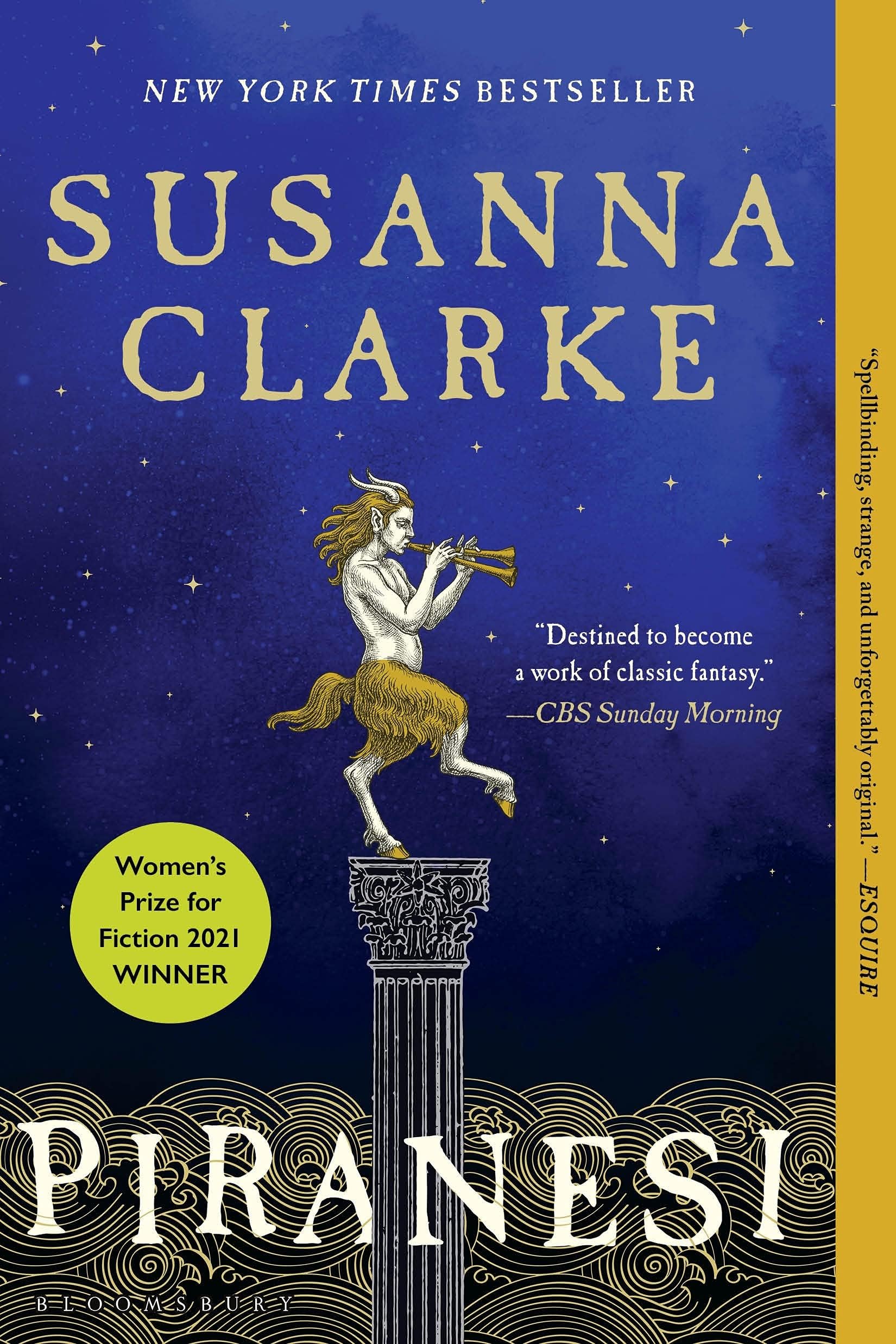
Piranesi [Clarke, Susanna] on desertcart.com. *FREE* shipping on qualifying offers. Piranesi Review: This one left me speechless… - Please bear with me, this will be long and a little spoilery I went into Piranesi knowing nothing, and I’m glad I did. I think that’s the only way this book should be read. What followed felt less like reading a book and more like slowly waking up inside a dream I didn’t know I was having. Every page felt like a revelation, yet the truth stayed out of reach. I was mystified, hypnotized. The House was a world of marble and ocean and impossible beauty, and I didn’t know whether to picture it as a vast temple or a decaying castle—but I felt it. The statues felt like memories I’d never had. Around 21%, I began to suspect the truth: that Piranesi was trapped, that The Other was no friend. But by then, I already cared for him—so deeply, so protectively. I didn’t understand him but I admired the way he loved his world with quiet reverence, how he found the silence to be a sacred thing. At 39%, the anxiety set in. He was trapped. I knew it. But how do you escape a prison you think is paradise? The beauty was laced with unease. From that moment on, through all the unraveling, what stayed with me most was Piranesi’s quiet resilience. The pain of remembering. The gentleness in the face of confusion. The way he tried to hold on to his wonder even as it slipped through his fingers. But then came the ending. And I was wrecked in a whole new way. The layers of grief, identity, healing—it’s staggering. I could cry again just thinking about it. Susanna Clarke didn’t just tell a story, she rebuilt my sense of reality. Piranesi is about madness, isolation, wonder, and the sacred. It’s about how the modern world forgets what’s important, and how we sometimes have to lose ourselves to see it again. Every detail is a quiet masterstroke. Review: Worth a read, but not in any way like Jonathan Strange and Mr. Norrell - Piranesi (although he suspects that is not his name) lives alone in a house so huge that it contains an ocean on its lower floors, and lakes in some of its ruined halls. The tides rush up its staircases, drowning the thousands of statues that line the walls. Piranesi lives by fishing in the lakes or the ocean, and cooks on fires made from dried seaweed. He keeps meticulous journals, which help him work out the times when two or more tides will combine and threaten to flood the level where he lives. Twice a week, a man whom Piranesi knows only as “the Other” visits. He occasionally brings Piranesi useful items: shoes, fishnets, cooking utensils, and has enlisted Piranesi in his search for “the Great and Secret Knowledge” – a method for becoming immortal, reading minds, and moving objects by telekinesis. One day, Piranesi finds words written in chalk on some of the walls and doorways of the house, giving directions to a particular room. On a later night, he sees the glow of a flashlight being used to explore some of the halls, and finds an unknown person has written a message in chalk on the floor. Although the Other has warned Piranesi that any person who comes to the house will try to harm Piranesi, he nevertheless writes a reply to the message. Prompted by the messages which he exchanges with the unknown person, Piranesi discovers that he has completely forgotten large portions of the events described in his journals. He begins re-reading early volumes to recover his memory of the events described. Gradually, with the help of the journals, and from messages exchanged with the unknown person, Piranesi discovers that Laurence Arne-Sayles, an English anthropologist and academic, had a theory that ancient man could communicate with natural forces in the world, and gain assistance from those forces. Several of Arne-Sayles’ students formed something like a cult around his theories. But then some of the students disappeared, and Arne-Sayles was convicted of kidnapping one student, who was found imprisoned behind a false wall in his house. His academic career ended with his conviction, although some of his remaining students continued to pursue his theories. Ultimately, Piranesi realizes that he himself was a newspaper reporter, researching a biography of Arne-Sayles. When he went to interview one of Arne-Sayles former students, now himself an academic, the former student transported Piranesi to the house where he now lives. Something in the nature of the house causes amnesia, and subsequent to his arrival in the house, Piranesi forgot his prior life. The unknown person who has been leaving chalk messages is revealed to be Sarah Raphael, a police officer investigating the disappearances of Arne-Sayles’ students. With her aid, Piranesi recovers his memory, and returns to the real world – although he still occasionally visits the house, which he finds peaceful and calming. Readers hoping for a return to the world of Jonathan Strange and Mr. Norrell, or of The Ladies of Grace Adieu, will be disappointed by Piranesi, which is not in any way like Clarke’s earlier books. Jonathan Strange and Mr. Norrell is a historical adventure novel, a love story, and a story of magic, all rolled into one. The book succeeds, in part, because it grafts a detailed magical history – peopled with uniquely drawn characters and going back to the Middle Ages -- onto the England of the Napoleonic wars. The appearance and use of magic in early 1800s England is shown not as some uncanny aberration, but as a continuation of that history. By contrast, Piranesi is not a historical novel, not a romance, and contains no magic – except for the ability to pass into the huge house described in the book, which seems to exist in an alternate dimension. Jonathan Strange and Mr. Norrell involved dozens of characters, each individually drawn, all interacting in a complicated plot extending over years and across much of Europe. It was complex, multi-faceted, and intricate. Piranesi has only four speaking characters, and the story – which extends over only nine months -- has none of the interwoven complexity of Clarke’s first book. Piranesi is a brilliant novel, but it is not set in the fictional universe that Clarke usually inhabits. It is almost as if George R. R. Martin gave us a hard-boiled detective story set in 1930s Los Angeles. It’s always a shock when one of your favorite authors changes her oeuvre, but the shock won’t delay me a minute in buying the next thing that Clarke writes.


| Best Sellers Rank | #1,139 in Books ( See Top 100 in Books ) #6 in Magical Realism #7 in Dark Fantasy #45 in Literary Fiction (Books) |
| Customer Reviews | 4.4 4.4 out of 5 stars (43,260) |
| Dimensions | 5.4 x 0.75 x 8.2 inches |
| ISBN-10 | 1635577802 |
| ISBN-13 | 978-1635577808 |
| Item Weight | 2.31 pounds |
| Language | English |
| Print length | 272 pages |
| Publication date | September 28, 2021 |
| Publisher | Bloomsbury Publishing |
O**H
This one left me speechless…
Please bear with me, this will be long and a little spoilery I went into Piranesi knowing nothing, and I’m glad I did. I think that’s the only way this book should be read. What followed felt less like reading a book and more like slowly waking up inside a dream I didn’t know I was having. Every page felt like a revelation, yet the truth stayed out of reach. I was mystified, hypnotized. The House was a world of marble and ocean and impossible beauty, and I didn’t know whether to picture it as a vast temple or a decaying castle—but I felt it. The statues felt like memories I’d never had. Around 21%, I began to suspect the truth: that Piranesi was trapped, that The Other was no friend. But by then, I already cared for him—so deeply, so protectively. I didn’t understand him but I admired the way he loved his world with quiet reverence, how he found the silence to be a sacred thing. At 39%, the anxiety set in. He was trapped. I knew it. But how do you escape a prison you think is paradise? The beauty was laced with unease. From that moment on, through all the unraveling, what stayed with me most was Piranesi’s quiet resilience. The pain of remembering. The gentleness in the face of confusion. The way he tried to hold on to his wonder even as it slipped through his fingers. But then came the ending. And I was wrecked in a whole new way. The layers of grief, identity, healing—it’s staggering. I could cry again just thinking about it. Susanna Clarke didn’t just tell a story, she rebuilt my sense of reality. Piranesi is about madness, isolation, wonder, and the sacred. It’s about how the modern world forgets what’s important, and how we sometimes have to lose ourselves to see it again. Every detail is a quiet masterstroke.
J**1
Worth a read, but not in any way like Jonathan Strange and Mr. Norrell
Piranesi (although he suspects that is not his name) lives alone in a house so huge that it contains an ocean on its lower floors, and lakes in some of its ruined halls. The tides rush up its staircases, drowning the thousands of statues that line the walls. Piranesi lives by fishing in the lakes or the ocean, and cooks on fires made from dried seaweed. He keeps meticulous journals, which help him work out the times when two or more tides will combine and threaten to flood the level where he lives. Twice a week, a man whom Piranesi knows only as “the Other” visits. He occasionally brings Piranesi useful items: shoes, fishnets, cooking utensils, and has enlisted Piranesi in his search for “the Great and Secret Knowledge” – a method for becoming immortal, reading minds, and moving objects by telekinesis. One day, Piranesi finds words written in chalk on some of the walls and doorways of the house, giving directions to a particular room. On a later night, he sees the glow of a flashlight being used to explore some of the halls, and finds an unknown person has written a message in chalk on the floor. Although the Other has warned Piranesi that any person who comes to the house will try to harm Piranesi, he nevertheless writes a reply to the message. Prompted by the messages which he exchanges with the unknown person, Piranesi discovers that he has completely forgotten large portions of the events described in his journals. He begins re-reading early volumes to recover his memory of the events described. Gradually, with the help of the journals, and from messages exchanged with the unknown person, Piranesi discovers that Laurence Arne-Sayles, an English anthropologist and academic, had a theory that ancient man could communicate with natural forces in the world, and gain assistance from those forces. Several of Arne-Sayles’ students formed something like a cult around his theories. But then some of the students disappeared, and Arne-Sayles was convicted of kidnapping one student, who was found imprisoned behind a false wall in his house. His academic career ended with his conviction, although some of his remaining students continued to pursue his theories. Ultimately, Piranesi realizes that he himself was a newspaper reporter, researching a biography of Arne-Sayles. When he went to interview one of Arne-Sayles former students, now himself an academic, the former student transported Piranesi to the house where he now lives. Something in the nature of the house causes amnesia, and subsequent to his arrival in the house, Piranesi forgot his prior life. The unknown person who has been leaving chalk messages is revealed to be Sarah Raphael, a police officer investigating the disappearances of Arne-Sayles’ students. With her aid, Piranesi recovers his memory, and returns to the real world – although he still occasionally visits the house, which he finds peaceful and calming. Readers hoping for a return to the world of Jonathan Strange and Mr. Norrell, or of The Ladies of Grace Adieu, will be disappointed by Piranesi, which is not in any way like Clarke’s earlier books. Jonathan Strange and Mr. Norrell is a historical adventure novel, a love story, and a story of magic, all rolled into one. The book succeeds, in part, because it grafts a detailed magical history – peopled with uniquely drawn characters and going back to the Middle Ages -- onto the England of the Napoleonic wars. The appearance and use of magic in early 1800s England is shown not as some uncanny aberration, but as a continuation of that history. By contrast, Piranesi is not a historical novel, not a romance, and contains no magic – except for the ability to pass into the huge house described in the book, which seems to exist in an alternate dimension. Jonathan Strange and Mr. Norrell involved dozens of characters, each individually drawn, all interacting in a complicated plot extending over years and across much of Europe. It was complex, multi-faceted, and intricate. Piranesi has only four speaking characters, and the story – which extends over only nine months -- has none of the interwoven complexity of Clarke’s first book. Piranesi is a brilliant novel, but it is not set in the fictional universe that Clarke usually inhabits. It is almost as if George R. R. Martin gave us a hard-boiled detective story set in 1930s Los Angeles. It’s always a shock when one of your favorite authors changes her oeuvre, but the shock won’t delay me a minute in buying the next thing that Clarke writes.
K**Y
Compelling fantasy novel about a man living in a house containing seas and statues
If I had to describe this fantasy novel in a single sentence, it would be something like this: A childlike man named Piranesi lives alone in a house with wondrous rooms that contain oceans and beaches with statues of figures from antiquity. I say he lives alone, but he is aware that another person lives in the house. Piranesi comes across evidence of this other man’s presence, and over time the man has left him gifts of snacks, shoes, vitamins, and useful tools for which he is grateful. Having learned how to take care of himself, Piranesi leads a simple life. He is curious about his world and documents what he does in journals containing all his observations. He has mapped the tides that flow in certain rooms and has wandered miles to explore different parts of the house. He has the habits of a naturalist or scientist but the naivete of a child. Piranesi has a vague awareness of another life. He knows how to read and write and has a disciplined mind, but he has lost his memories. He spends his time working on his journals, mapping the house, and scavenging for food and shelter. Occasionally, Piranesi will think about other people. He has found human bones, so he knows there have been others before him. These bones he treats reverentially. Piranesi starts communicating with the other man, named by him as the Other, through written messages. When he finally meets the Other, the man tells him of another man who will visit the house and of whom he should be afraid. One day, Piranesi meets the man the Other warned him about. He calls him the Prophet because he seems to know so much about the house, other people's existence, and surprisingly, him. Piranesi reflects on all that the Prophet has told him and begins to realize that answers to the questions he is beginning to have might be found in his earliest journals which now number more than 20. What he finds completely changes everything that he has known to be true about himself and his world. He learns his life is threatened but has an unexpected ally. Susanna Clarke has created a fantastic world that celebrates nature. The reader appreciates this world through the eyes of a gentle man. It’s a place that’s unlike any other. It has dreamlike descriptions and takes the reader on a journey. I found the level of detail and the descriptions a little confusing at first. It may take some time to get used to the journal-like format. There are so many rooms it's hard to keep track. At some point, I stopped trying to remember which room was which and let the story take over. It does reward the reader with an engrossing tale. If you are looking to take an armchair journey to an exotic place, this may be your book.
T**S
Original, estimulante, misterioso e profundamente filosófico. Ao longo da leitura imaginei várias explicações para o mundo de piranesi, mas não cheguei nem perto de adivinhar o final. Já entrou na minha lista de "preciso ler de novo".
P**S
Absolutely LOVED this book. Never read anything quite like it. Fantasy and reality and sadness and betrayal and belonging and mystery, all wrapped up in the most amazingly constructed narrative. I have read Johnathan Strange and Mr Norrell. This is very different, but still engaged me with awe. Every page was a new adventure in thinking and feeling. I would love to read more by this author.
R**B
Está cargado de fantasía sobria, misterio, muy entretenido, pero ojo, está contado por medio de entradas del diario del protagonista. Lo recomiendo mucho.
D**D
I feel like I always start my book reviews with "this wasn't what I expected" but it's important for you to know that the majority of books I read are ones that have been recommended to me by friends (a very small circle of readers who I trust to know my personal tastes) or books I've randomly picked up in a shop, read the blurb, and brought home with me. It's also worth noting that for whatever reason a book has made its way to my tbr pile, it usually will sit there for quite some time before I actually sit and read it, simply because I have so many waiting for my attention. Despite this, I'm going to say that while this book wasn't what I was expecting, I'm not sure if I even knew what that was when I first started reading. I genuinely had no idea what the book was about really, I don't even remember buying it (it might have been a gift?) but it was next on the pile, and so, I read it. And I loved it. It's an absolutely magical book, full to the brim with stunning visuals, a unique and beautiful backdrop, and a main character who gets himself lodged straight between your ribs and takes up residence there. It was so cleverly written, where we as readers weren't told very much at all until quite deep into the book, but still feeling so immersed in the world as we followed Piranesi around his peculiar home. The setting is lovely, the house is full of peril and beauty in equal measure, and you can feel the main character's love and admiration all the way through the story. While the story itself takes a dark turn, it's not jarring at all, the narrative leads us from the bright ocean and Piranesi's innocent demeanor, through to themes of manipulation, deceit, betrayal, and eventually faces us with self-belief , what we know to be reality, and our own perceptions of identity. All in all it's a very clever book, and one that hit me emotionally from the first page to the last. If you enjoy speculative fiction with mystery, but written with tenderness for the human condition, I would really recommend this book.
B**E
“Piranesi” is one of the more original and unexpected book I’ve read of late. You start a journey in a reality which recalls Plato’s world of ideas in the shoes of a naïf and innocent protagonist who is far away from the modern age characters we are used to. Thanks to the “journal” narration, you get entangled in his peculiar psychology, seeing the world from his perspective and sympathizing with him when all his certainties start to collapse. Highly recommended reading.
Trustpilot
2 weeks ago
2 weeks ago