

Desertcart purchases this item on your behalf and handles shipping, customs, and support to KSA.
🔩 Elevate your woodworking game with precision-crafted joints that demand attention!
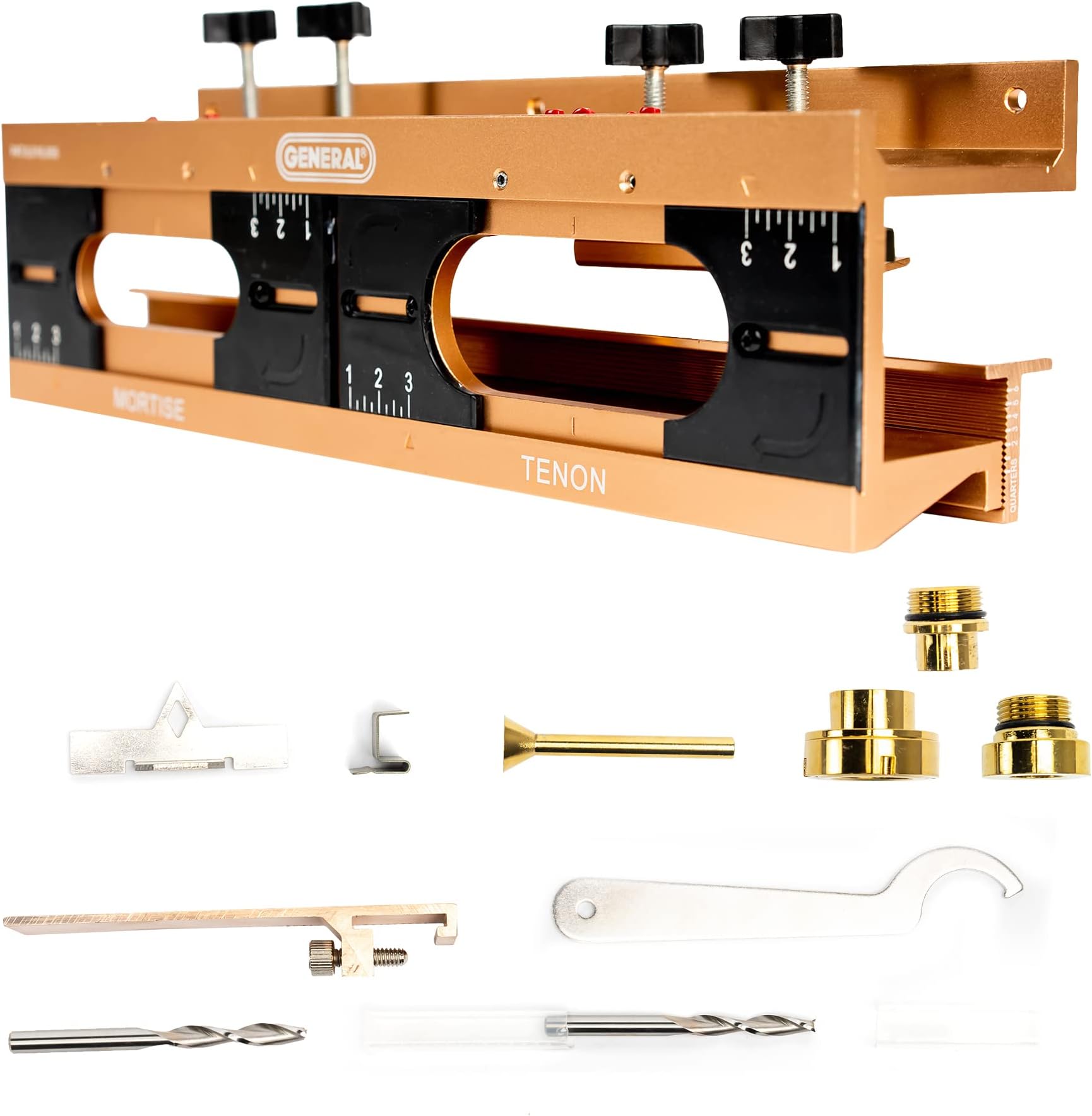
The General Tools Mortise and Tenon Jig is a durable, aircraft-grade aluminum drill template set designed for professional-quality mortise and tenon joints. It features adjustable clamps and swing arms for precise wood alignment, supports joint sizes from 1/4" to 1" wide and 1" to 3" long, and includes a versatile bushing kit compatible with any plunge router. Ideal for cabinetry, furniture, and frame projects, this jig delivers strong, stable joints with ease and reliability.


| ASIN | B00563TL2Y |
| Batteries Included? | No |
| Batteries Required? | No |
| Best Sellers Rank | #574,352 in Tools & Home Improvement ( See Top 100 in Tools & Home Improvement ) #1,424 in Power Tool Accessory Jigs |
| Color | No Color |
| Customer Reviews | 3.9 3.9 out of 5 stars (523) |
| Date First Available | June 22, 2008 |
| Included Components | 1/4" Spirit Router bit, Bushing kit, Wrench |
| Is Discontinued By Manufacturer | No |
| Item Package Quantity | 1 |
| Item Weight | 1 pounds |
| Item model number | 870 |
| Manufacturer | General Tools |
| Material | Plastic |
| Part Number | 870 |
| Power Source | corded-electric |
| Product Dimensions | 15 x 4 x 4.2 inches |
| Shape | shape |
| Size | No Size |
| Usage | specific_uses_for_product |
| Warranty Description | 1 year parts |
A**R
Great Jig in my experience
I have used a number of commercial jigs over the 40+ years that I have been woodworking (hobby). I would say the General mortise and tenon jig is very close to some of the most expensive jigs that I have ever used (e.g., Leigh) in terms of ease of use, accuracy, and overall function. So far, I have only used the jig to make 1/4 inch thick mortise and tenon joints for small cabinet doors. It was easy to learn and set up, and the joints are tight and accurate. My only complaint is that the mechanism for tightening the wood in place are hard on the fingers
D**N
Great Concept but Needs Some Work
This jig is made of solid aluminum and very sturdy. Instructions are very well written by someone who obviously speaks English as his primary language. It needs to be mounted on a board and clamped to your benchtop. The concept works well--tenons fit nicely into mortises. But it's tedious. I'm building a kennel for my dog and bought the jig to make the joints for the many (21) bars and corner joints. Boards are held in place by two clamps--one for mortises and one of tenons. Each clamp has two thumbscrews which must be tightened and released by turning the screws alternately several times. Not a big deal--unless you're making a lot of repetitive cuts. A simple lever clamp would improve the process immensely. When I went to the website to register my jig, I couldn't because the item has apparently been discontinued. Too bad, because it could be easily upgraded to make it more efficient and accurate.
T**A
Great jig
Bought this for making cabinet face frames. I'm not sure why so many are leaving bad reviews for it: read the manual, take the time to set it up correctly and use a little sense and it’s a terrific tool. Honestly, I'm NOWHERE on the professional scale. This is my first attempt at making true joined face frames and I found it a breeze. Again: read the instructions, read them again because you were probably in a hurry the first time.... then take the time to set up and learn the tool and you should have no problems. The only complaints I have: 1. it did not come with a manual. I had to visit the manufacturers website and do some searching to find the manual, download, and print a copy. 2. There were two included accessories that were not mentioned anywhere in the manual, a stop clamp for repeatable cuts, and two small clips to act as 1/2" shims when mounting stock less than 2" wide. I figured them out, but it would’ve been handy to have them referenced.
G**G
Not as easy to use as it SHOULD be - needs very careful set up
Before you get this in your hands it looks like a very useful thing to have. It is pretty good up to a point but the previous reviewers have made the important points. It IS difficult to line up the centers by eye. I've worked round this to a point by using a square across the jig because it makes it easier to see, then putting a stop into the jig to make sure my materials (especially for cutting the tenons) is REASONABLY in the same position every time. It also ensures that the work piece is perpendicular to the cut in ONE direction (but only one - see below.) I have three other "complaints" one of which has already been mentioned several times where the clamping device is not really sufficiently accurate. I would also like to have seen the actual clamping plate increased in height (towards the top of the jig) to accommodate material smaller than 2" without the necessity for using spacers. The 1/2" clips supplied to be used as spacers are not good - difficult to attach and not really reliable. I use a 1/2" metal spacer bar to improve that. My MAJOR issue is with the pieces to vary the length of the cuts. They are made of a plastic which is not sufficiently strong to resist the pressure from the Allen screw intended to hold it in place. This is specifically a problem when you're cutting a mortise or tenon which is not at the maximum or minimum length. If you tighten the screw so that it doesn't crush the plastic the adjustment piece is loose enough to move. If you tighten the screw sufficiently to prevent it moving it starts to deform the plastic. Also the plastic guides move from side to side within the track intended to hold it in position. It's simply not a tight enough fit. If these guides had been made in Aluminum and the dimensional fit improved to the track location they would have been far more effective and reliable. The third issue (which MAY be solved by increasing the height of the clamping plate) is that the jig does not keep the work piece perpendicular in the front to back plane which is quite frustrating. I have had to resort to adding a piece to my work bench to correct this. I've only done two projects with the jig, 36 mortises and tenons in Poplar, and the 1/4" bit included is already worn out. On the whole, for the price, I do like the jig. Once you've got it set up it's obviously a LOT quicker than cutting the joints by hand. It takes quite a lot more setting up than I expected but compared to the cost of a drill press and mortising attachment this is a very inexpensive option. Unfortunately that cheapness is somewhat reflected in the performance. I think some fairly minor changes in the construction might correct some of these issues and turn it from a 3 star to a 5 star purchase. It's OK for the amateur / intermediate skill woodworker but it's not rally an option for any kind of larger scale production. I'd recommend it to people at that level with the provisos regarding set up time and accuracy.
A**L
Good Quality but Poor Performance
The purpose of a woodworking jig is to allow the user to make repeatable cuts. The key is each cut is the same. Not nearly the same, but exactly the same. A jig that allows movement of the wood or depends on eyeballing the cut in some way is not a good jig because the cuts will not be the same. I struggled for hours with this jig and could not make exacting cuts with it because of two major design flaws: 1) not clamping the wood sufficiently - the wood moves unless the clamps are super tight, and 2) not having a way to hold the wood in the exact same location time after time. The General Mortise and Tenon Jig is made pretty well; however, there is one flaw in its holding power. The internal clamps that hold the wood in place do not do the job. Even with these clamps twisted down very tightly the wood will move, especially on the tenon parts. If one were to glue sandpaper to the internal clamps or make them larger it might work; however, after paying this much for a jig I do not want to tweak it this way and that to make it work well. It should work well out of the box. The second design flaw revolves around how the user aligns the wood before cutting. The jig instructions tell you to mark each piece at the center of the cut. Then the user puts the wood into the jig and aligns it by sight on center lines on the jig. There is no stop to adjust so the wood goes into the same spot each time. No matter how careful I was the parts were never aligned exactly the same. There was at least a 1/32 difference in the alignment of the wood. Usually it was more, sometimes much more. My problem is I am 65 years old and even with my glasses and a lot of light the marks on the jig and the marks on my wood ended up misaligned. The key here is a lack of a stop. In addition, the stop for the depth of the wood is basically made for 1/2, 3/4, and one inch stock. It is not made for metric sizes (such as plywood). If the stock is slightly smaller or larger than standard sizing it is impossible to get the stock centered on the depth dimension. Even after numerous tries at alignment the stock was at least 1/32 off. The system just does not work. If your stock is exactly 3/4, 1/2 etc I think one could aline the depth dimension eventually. If your stock is off "standard" imperial sizes stand by for problems. The internal clamps were rather small, and the knobs one has to use to twist the clamps closed are small. My hands have arthritis and turning the small knobs was hard. To top that off one must tighten these knobs excessively to have a chance at holding the wood in place. There are two knobs for each clamp, and the user must tighten both over and over until both are REALLY tight. Tightening one seems to cause the other to need more tightening. With a playing card or two I probably could have brought the depth adjustment onto the exact center of the wood, thus solving the depth problem. Then I could have cut the mortise parts long and just cut off the excess to get an exact fit on the joint. By cutting the parts a little oversized I could simply bring the frame (or whatever) into square after it was constructed. But why am I paying $100 to build a frame that isn't right from the get go? Do I have to build every joint this way? The entire point of a jig, especially an expensive one, is to place the cuts in the same spot on the stock every time. Thus, the wood must be held against a stop, the clamping mechanisms must hold the wood tightly without me putting in extra effort to sandpaper the front of the clamps etc, and the jig should be easy to use. One must remember that a jig may have to help the user cut 20 or more joints on a single project. Any additional work to square up the joint or work out "minor" problems becomes a major headache. I can make a shop jig for next to nothing that accomplishes that much. When I start paying $100 plus for a jig it has to eliminate those problems completely. This jig fails to do that. The jig does have mostly well machined parts. The router bit and the template guides are very good. The little wrench made to tighten the template guide onto the router base could not be used on my router, but that was a small concern. The centering process for the router bit was very good I thought. The instructions are good enough if you read them over once or twice before starting. Why the internal clamps were not better is beyond me. Why make the faces of the clamps smooth? Why not make the screws advancing the clamps larger and make the knobs either larger or of a different design so they could be tightened without a problem? Why make the alignment lines so thick? If they were much finer it might be easier to align the wood correctly. Why not design in a stop for the wood parts so every cut will be the same? It would be so easy to make this jig a lot better. And I don't think the ideas I have set forth would cost all that much. Nonetheless, the jig does not pass muster. One star. AD2
F**I
Five Stars
It takes some practice to get it right, but it's worth the effort. Buy some replacement bits. You'll need them. Since I purchased this jig a long time ago, I've made some modifications to it. I replaced the tiny wing nut bolts with some bigger and longer bolts to tighten the wood. I lined the inside of the clamps with sandpaper to help hold the piece in place. For the tenon section, I added a vertical runner next to the jig to help with the alignment. I should not have had to make these adjustments, but to make it work correctly, I had to.
R**E
Easy to use - but size limited
This jig is really easy to use, but is size of the mortise and tendons are limited. If you are doing smaller (less than 2-in long x 3 1/2-in wide) projects it is perfect so keep that in mind.
R**.
Nice jig but things need to be perfect
If this company would just provide a router base plate with the exact size needed to house their parts everything would have worked much better for me. First off you must have a plunge router to use this gig. They dont really tell you that. Then you have to have a router base plate that has a 1 & 3/16" center hole that also has a 1 & 3/8" counter bore in that plate for the center bushing to nest into. I spent a ton of time online and in stores trying to find the exact plate I needed and never really found anything so I had to improvise one. Also if you wood is not exact dimensions like 1/4", 1/2", 3/4" you will have trouble using this gig and getting things centered. Also very hard wood was a challenge but that was because of the wood mainly. All in all I believe this gig can do a really nice job and I watched a video that showed a guy using it for the first time and making a nice joint. The company should really provide a universal base plate for the money.
G**E
Quality jig
Well made, easy to use
D**R
bon produit
bon produit mais prise en main un peu fastidueuse
A**R
does what it says on the box
good works for me
W**S
Gabarito espiga general tools
Muito preciso
M**R
Works very well and comes with good instructions. There are also some very useful videos on YouTube
I use this jig for creating joints to make drawer rails in reproduction desks and cabinets. I had a small issue out of the box. There are small black Allen key slot locking bolts for the movable templates to size the mortise and tenon lengths. The RHS bolt for the tenon template came new with the Allen key slot stripped out so that I could not loosen the bolt leaving the template set at the widest point. Eventually after a spray with Reducteur H72 bolt loosener, I managed to get the bolt loose and out and I then replaced all 4 template locking bolts with the same thread size stainless steel pan head bolts. After that, the jig met my expectations.
Trustpilot
3 days ago
1 month ago