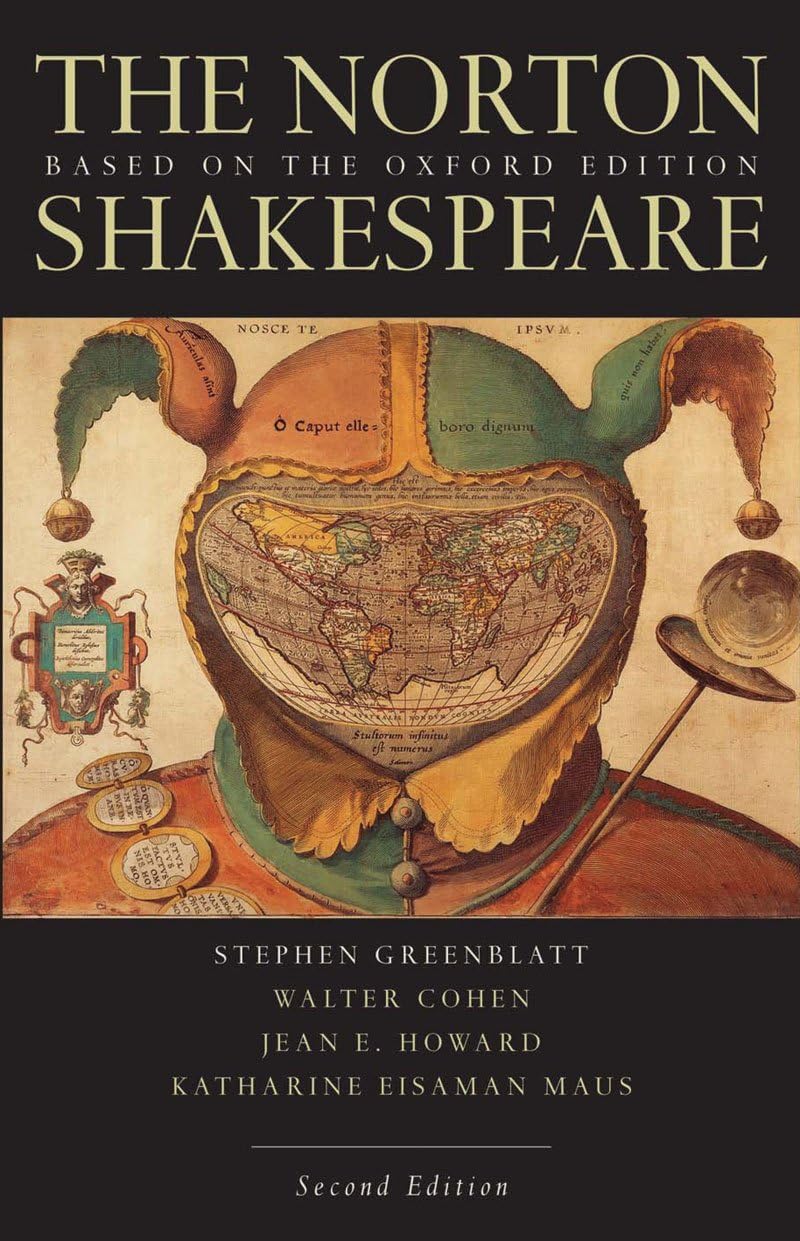
The Norton Shakespeare
Product ID: 2064911
Desertcart purchases this item on your behalf and handles shipping, customs, and support to KSA.
Instructors and students worldwide welcomed the fresh scholarship, lively and accessible introductions, helpful marginal glosses and notes, readable single-column format, all designed in support of the goal of the Oxford text: to bring the modern reader closer than before possible to Shakespeare's plays as they were first acted. Now, under Stephen Greenblatt's direction, the editors have considered afresh each introduction and all of the apparatus to make the Second Edition an even better teaching tool. Review: The Edition of Editions - Dearest reviewers, interested buyers, students, etc. etc, Hyperboles are usually pompous and pointless unless they're written like Kurt Vonnegut or Orwell would express them. They are exclusive and tend to say more about the person making them than about the thing being praised. But once in a while I think we have a right to make them, when the subject earns it. So it is with the Norton. I love Shakespeare. I have studied him (and works about him) for years now in most imaginable mediums, and have at one point or another owned every important edition of his complete works there is. But I keep on coming back to the Norton, which is an astonishing labor of love, devotion, respect and meticulous scholarship. The Norton and the Riverside, most people agree these are the two supreme editions. But I prefer the second edition of the Norton. This is why: -It is new. Published in 2008, it contains the most recent scholarship, along with the Bate's RSC and Bevington's sixth and seventh editions. It's based on Mr. Stanley Wells's Oxford Edition, which most (but not all) scholars consider the crowning achievement of twentieth century Shakespeare studies. It'll probably seem just as new in 2020 as now. -It is well-respected. Stephen Greenblatt, a brilliant fellow, is the chief editor of the Norton. His Will in the World was on the NY Times bestseller list for weeks and he's practically the father of one of the main branches of literary theory alive today. He probably knows what he's doing better than most of us. Harold Bloom (who's obviously insane) hates the Oxford Edition, which the Norton is based on, but Marjorie Garber used the first edition of the Norton for her bestselling book 'Shakespeare After All,' probably the most read book of Shakespeare criticism of the decade. If such an illustrious scholar thinks it's the edition to use, surely it's not so bad as the critics say. Besides, the Norton doesn't retain the Oxford's quirkier emendations. Hamlet has everything you could imagine; Falstaff is still Falstaff, thank God; Troilus and Cressida retains its epilogue. King Lear, like in the Oxford, comes in three editions. This is really great because there are two totally different editions of the play, and what most people have read until now was a conflated version. Now, the brave of the world can observe the play in two stages of Shakespeare's consciousness (or editorial process, which you will). Great stuff. -It is compact. Unlike the RSC, it does not fall apart after being opened twice. Its binding is not sewn, but it will last at least three decades with proper management, and more if you buy glue for five bucks from desertcart to patch it up when little cracks start to appear. -It is simple. The cover is classical and it doesn't scratch easily, and it comes with a slipcase, which is a great bonus. -The format is one-column. Makes reading easy and less daunting. It's like reading those individual Folger editions. -It is cheap. It's selling for only $40-something now; when desertcart doesn't have the slipcased edition ready, it sells for around $70, which is still a little less than Riverside and Bevington. -Its introduction is extraordinary. New Historicist mostly, with lost of cultural materialism and not a lot of metaphysics or actual focus on criticism, but it's the best introduction to Shakespeare's time in any complete works. The introductions to the individual plays are always enlightening, and there are bibliographies and film lists before each play, too. Nice pictures too. Who can ask for more? -The notes are superb. There are more than in the Riverside or the Pelican (the first 5 or so lines of Antony and Cleopatra have nearly twice as many notes in the Norton as in the Riverside). They are written on the same line as the text, with bubbles next to the unusual word, which saves a lot of time when you're reading. The first part of Henry IV took me about three hours to read in this one; in most other editions it takes four or five. -It has everything Shakespeare wrote, unlike the RSC, which lacks A Lover's Complaint based on Brian Vickers's argument that John Davies wrote it. The argument is impressive but unproven. It also has Kinsmen, unlike The Pelican. It has Shakespeare's Will and lots of cool documents related to his life. No Edward III, but its authorship remains unprovable, so a justifiable emission. -When all's said and done and you still don't like this book, just use it as a weight. You'll be fit for the next Olympics in no time and you'll save lots of gym money. There are some other things, but these are the main reasons why I love the Norton. There will always be naysayers and critics. Some will argue about the thinness of the paper, the strangeness of the text, the thickness of the book. But we must look at the advantages and compare them with the disadvantages. I am glad I came across the Norton and I consider it my most prized secular book. And so it should be in every English-speaking home. It is an edition worthy of The Poet's eternally inspiring and inspired works and of the library of any scholar, teacher or student of the human soul. I hope this helped prospective buyers. And so ends my catechism. Review: Explanatory Notes Are Awesome! - I want to preface this by saying while I'm not qualified to evaluate the scholarship behind the notes and essays on the plays in this edition because I don't have any sort of background that would allow me to do so, to me it seems to be a highly useful edition. This is something I bought as a gift for myself, not for part of a class, because while I enjoy reading Shakespeare's plays, neither the digital edition nor the previous print edition I owned had much in the way of notes that explained differences in word connotations and denotations (meanings for somethings have shifted or mutated a bit over time) or cultural references that audiences in his day would have understood but are more obscure now. This edition has explanatory notes galore, and I feel like it has improved my enjoyment of reading these plays tremendously and it's like adding flesh onto a skeleton how different they look to me when I'm reading from this edition. I have found this edition is also very helpful to understand the "slang" of the day. I grew up in the '80's, right? So, I get "rad" and what it means, but there's a possibility someone who grew up 30 years later would have to google it. So I would say it's definitely a thing of value that has improved my understanding of this work. There is also a bit of an overview of the relevant history for the time period Shakespeare was writing at the beginning of this edition that I found helpful as well. I bought my copy used, and it came in great shape. So just from the perspective of a casual reader who enjoys great literature, I found this edition to be very helpful in enhancing my enjoyment and understanding of these plays and can definitely recommend it from that standpoint.
| Best Sellers Rank | #940,933 in Books ( See Top 100 in Books ) #114 in Drama & Play Anthologies (Books) #188 in English Literature #1,904 in European Poetry (Books) |
| Customer Reviews | 4.6 out of 5 stars 181 Reviews |
P**C
The Edition of Editions
Dearest reviewers, interested buyers, students, etc. etc, Hyperboles are usually pompous and pointless unless they're written like Kurt Vonnegut or Orwell would express them. They are exclusive and tend to say more about the person making them than about the thing being praised. But once in a while I think we have a right to make them, when the subject earns it. So it is with the Norton. I love Shakespeare. I have studied him (and works about him) for years now in most imaginable mediums, and have at one point or another owned every important edition of his complete works there is. But I keep on coming back to the Norton, which is an astonishing labor of love, devotion, respect and meticulous scholarship. The Norton and the Riverside, most people agree these are the two supreme editions. But I prefer the second edition of the Norton. This is why: -It is new. Published in 2008, it contains the most recent scholarship, along with the Bate's RSC and Bevington's sixth and seventh editions. It's based on Mr. Stanley Wells's Oxford Edition, which most (but not all) scholars consider the crowning achievement of twentieth century Shakespeare studies. It'll probably seem just as new in 2020 as now. -It is well-respected. Stephen Greenblatt, a brilliant fellow, is the chief editor of the Norton. His Will in the World was on the NY Times bestseller list for weeks and he's practically the father of one of the main branches of literary theory alive today. He probably knows what he's doing better than most of us. Harold Bloom (who's obviously insane) hates the Oxford Edition, which the Norton is based on, but Marjorie Garber used the first edition of the Norton for her bestselling book 'Shakespeare After All,' probably the most read book of Shakespeare criticism of the decade. If such an illustrious scholar thinks it's the edition to use, surely it's not so bad as the critics say. Besides, the Norton doesn't retain the Oxford's quirkier emendations. Hamlet has everything you could imagine; Falstaff is still Falstaff, thank God; Troilus and Cressida retains its epilogue. King Lear, like in the Oxford, comes in three editions. This is really great because there are two totally different editions of the play, and what most people have read until now was a conflated version. Now, the brave of the world can observe the play in two stages of Shakespeare's consciousness (or editorial process, which you will). Great stuff. -It is compact. Unlike the RSC, it does not fall apart after being opened twice. Its binding is not sewn, but it will last at least three decades with proper management, and more if you buy glue for five bucks from amazon to patch it up when little cracks start to appear. -It is simple. The cover is classical and it doesn't scratch easily, and it comes with a slipcase, which is a great bonus. -The format is one-column. Makes reading easy and less daunting. It's like reading those individual Folger editions. -It is cheap. It's selling for only $40-something now; when amazon doesn't have the slipcased edition ready, it sells for around $70, which is still a little less than Riverside and Bevington. -Its introduction is extraordinary. New Historicist mostly, with lost of cultural materialism and not a lot of metaphysics or actual focus on criticism, but it's the best introduction to Shakespeare's time in any complete works. The introductions to the individual plays are always enlightening, and there are bibliographies and film lists before each play, too. Nice pictures too. Who can ask for more? -The notes are superb. There are more than in the Riverside or the Pelican (the first 5 or so lines of Antony and Cleopatra have nearly twice as many notes in the Norton as in the Riverside). They are written on the same line as the text, with bubbles next to the unusual word, which saves a lot of time when you're reading. The first part of Henry IV took me about three hours to read in this one; in most other editions it takes four or five. -It has everything Shakespeare wrote, unlike the RSC, which lacks A Lover's Complaint based on Brian Vickers's argument that John Davies wrote it. The argument is impressive but unproven. It also has Kinsmen, unlike The Pelican. It has Shakespeare's Will and lots of cool documents related to his life. No Edward III, but its authorship remains unprovable, so a justifiable emission. -When all's said and done and you still don't like this book, just use it as a weight. You'll be fit for the next Olympics in no time and you'll save lots of gym money. There are some other things, but these are the main reasons why I love the Norton. There will always be naysayers and critics. Some will argue about the thinness of the paper, the strangeness of the text, the thickness of the book. But we must look at the advantages and compare them with the disadvantages. I am glad I came across the Norton and I consider it my most prized secular book. And so it should be in every English-speaking home. It is an edition worthy of The Poet's eternally inspiring and inspired works and of the library of any scholar, teacher or student of the human soul. I hope this helped prospective buyers. And so ends my catechism.
A**I
Explanatory Notes Are Awesome!
I want to preface this by saying while I'm not qualified to evaluate the scholarship behind the notes and essays on the plays in this edition because I don't have any sort of background that would allow me to do so, to me it seems to be a highly useful edition. This is something I bought as a gift for myself, not for part of a class, because while I enjoy reading Shakespeare's plays, neither the digital edition nor the previous print edition I owned had much in the way of notes that explained differences in word connotations and denotations (meanings for somethings have shifted or mutated a bit over time) or cultural references that audiences in his day would have understood but are more obscure now. This edition has explanatory notes galore, and I feel like it has improved my enjoyment of reading these plays tremendously and it's like adding flesh onto a skeleton how different they look to me when I'm reading from this edition. I have found this edition is also very helpful to understand the "slang" of the day. I grew up in the '80's, right? So, I get "rad" and what it means, but there's a possibility someone who grew up 30 years later would have to google it. So I would say it's definitely a thing of value that has improved my understanding of this work. There is also a bit of an overview of the relevant history for the time period Shakespeare was writing at the beginning of this edition that I found helpful as well. I bought my copy used, and it came in great shape. So just from the perspective of a casual reader who enjoys great literature, I found this edition to be very helpful in enhancing my enjoyment and understanding of these plays and can definitely recommend it from that standpoint.
A**.
Best Value in a one-volume Shakespeare
Let's get the simple stuff out first: this is a beautiful book; the introductions are smart and lively; all the plays are by Shakespeare. Based on these alone, how can I rate it only four stars and not five? I'd venture to say that this is all the Shakespeare most people will need and then some. And it's 30% less than the Riverside, so I heartily recommend buying it. So now for the minor quibbling. When Riverside updated its collected Chaucer in the 1990s, it produced a book that looks very much like this Norton Shakespeare. It had all new introductions and notes, a cleaned up text, more pictures, and was actually about twice as large as the previous standard Chaucer (which was just Riverside's own earlier edition). But the Riverside Chaucer tracks recent Chaucer scholarship closely, in notes and not just the introductions. Someone writing about Chaucer could start their research with that text and follow its very credible recommendations for further reading. That element is much weaker in the Norton Shakespeare, which tackles general themes well but doesn't do the same close work of tying in Shakespeare criticism. Yes, this is a nitpicky point, but for a text that's clearly being positioned to take over the market, I had hoped it would do a little more to keep the teaching and research strands more fully in conversation. This is still the one-volume Shakespeare I would buy for myself, now. If you want even less apparatus, try the Oxford Shakespeare (same texts of the plays, $26). If you need more background any one play, I like the Arden editions of individual plays.
M**B
A Truly Historical Shakespeare
There are many editions of Shakespeare's works. What makes this particular one stand out is the range of critical offerings appending his writings. The essays and notes in this edition (based on the celebrated Oxford edition) help us understand Shakespeare not as some creative mastermind who stepped out of a void but as a commercial playwright in Renaissance England who constantly engaged with the literary and historical writings popular in his day. Though he certainly valued his craft, he treated his plays not as ossified works of art but as scripts for potentially riveting commercial productions that would bring profit to his employers and thus willingly engaged in collaboration with other company members, including other playwrights, to help make his plays as usable as possible. What may work for publication would not necessarily do for a theatrical performance so scripts had to be trimmed or re-written to fit the needs of the audience. Only when we understand that can we finally move past pointless debates about whether there exists a "master text" for King Lear and other plays, how he achieved his literary revolution, why some plays are not as consistently brilliant as others or whether he (a country schoolboy) truly wrote all of the plays that bear his name, as opposed to someone "more educated and wordly" like Edward de Vere or Francis Bacon. He wrote not with the pomp and self-importance attributed to him by contemporary bardolators, but as an extremely talented company playwright and poet who was constantly revising and rewriting his work to meet the needs of a performance, taking inspiration from those popular writings he could lay his hands on to guarantee maximum popularity. All at a time when theater became a key source of entertainment for a wide cross-section of post-feudal English society. Greenblatt's general introduction and the introductory essays in this volume help us understand this particular historical moment when Shakespeare arose, how that moment defined him and his plays, and how his plays traveled beyond that moment to become the most influential writings in the English language. This is a volume that takes what I feel to be a truly historical approach to Shakespeare that ties him down in order to truly grasp what made him so great and transcendent. As James Joyce once said, "in the particular lies the universal", and only by looking at Shakespeare as he was do the editors present us with why he truly became "not just of an age but for all time."
M**R
Best Shakespeare One-volume Edition
This is the best, most scholarly one-volume edition of the complete works of the greatest writer humankind has ever known. It has a solid 76-page-long fact-packed General Introduction by Stephen Greenblatt. It has modern spelling, thousands of notes, and thousands of clarifying modern synonyms--example, "shirt" means man and "smock" means woman. Each of the 43 plays has a masterful introduction by any of these scholars: Stephen Greenblatt, Walter Cohen, Jean E Howard, and Katharine Eisaman Maus. It's printed in lightweight offset paper (aka bible paper) because it has 3420 pages. This edition is the only one needed by a Shakespeare student, reader, or actor. 😺
I**E
Wishing for an e-version
The 2nd edition of the Norton Shakespeare is what it is, a second edition. All be it the foward and play introductions have been updated to reflect what has been learned about Shakespeare and his works since the last publication; it's still a heavy tome at 6 pounds. For those of us using this as a text, which is what the Nortan Shakespeare was meant to be, it's a huge burden. The publisher needs to come out with the e-version soon; save our backs, please!
S**N
Excellent collection
A set of Shakespeare's complete works is a must-have for any literature lover, and this book is certainly worthy of your bookshelf. While many similiar collections use microscopic words or obnoxiously short margins to deliver information in a smaller book, this edition is thorough and complete (without seeming to cram words onto the page.) The book begins with a one hundred page introduction and is followed by all of Shakespeare's works in the order that they were believed to be written. For fans looking to "get to know" Shakespeare, this system is perfect; for the average person interested in a few individual plays or sonnets, the table of contents obviously makes single works easily accessible. Each work is preceded by several pages of description and analysis. Again, great for enthusiasts, skippable for anyone uninterested. The Norton Shakespeare deserves all five stars AND is a wonderful value. I would have paid twice as much, and I highly recommend it for anyone looking for a worthy "Shakespeare Complete Works."
M**E
If you love Shakespeare...
...then THIS is the book for you!!! I'm taking my second Shakespeare class and, while this book was more expensive than the paperbacks we used in my undergraduate class, it's nice to know that I will always have what I need, when I need it. The first 100 pages of introduction are interesting and informative. The maps and documents are also well worth reviewing. Probably two of the more useful things are the Shakespeare Genealogy at the front and the Genealogies of the Houses of York and Tudors/Stuarts in the back of the book. Do I recommend this? Most definitely!!!
L**R
All the Shakespeare you'll ever want
This is a bargain buy, all of Shakespeares works in one volume with accompanying notes and essays. This is one of the set texts that is recommended by the OU when studying Shakespeare (which is why I bought it) the only warnings I would point out are: it's a very thick book and so difficult to have lying open on your desk and very heavy for carrying around. The pages are VERY thin, so you can't really use a highlighter on them or make notes in the book. However, these don't detract from the fact that this is an excellent book and a very good buy.
I**S
Enlightening
The most enlightening Ever 👍🏻👌🏻💯💯
A**N
Beautiful volume
It has that super thin, what I call "Bible paper" that adds to the atmosphere of the book. Helpful translations of words that are no longer in common use listed on the outside of the page, line numbers by the 5 on the inside. Footnotes are also provided about historical details. I purchased this as a required text for a university course. My prof has used the first edition, and now the second in teaching the course and believes this is the "ultimate" Shakespeare compilation. The intro essays before each play are also enlightening, although they can change your read of the play (for example, in Antony and Cleopatra, the author really turns up her riggish-ness, when in reality, Shakespeare turned it down). The picture of the product is a bit misleading, it does come with a dustcover that mirrors the hard outside sleeve. This is one textbook I won't be re-selling!
B**N
Shakespeare
Great Price for a book that you will have for a long time.
C**O
A must have
A must have for any literature student or any fan of Shakespeare. It has all of his works, with wonderful notes that will help you understand the context of a sonnet, or a play in which they were written. Each chapter has a long historical explanation, with facts about politics and other data about Shakespeare. It's quite huge so you can't go around carrying it in your purse, but the binding and the paper are of very good quality, I think it will last a life time!
Trustpilot
2 months ago
2 weeks ago