

Buy anything from 5,000+ international stores. One checkout price. No surprise fees. Join 2M+ shoppers on Desertcart.
Desertcart purchases this item on your behalf and handles shipping, customs, and support to KSA.
🎤 Elevate your sound with ART Tube MP Studio V3 — where vintage warmth meets modern precision.
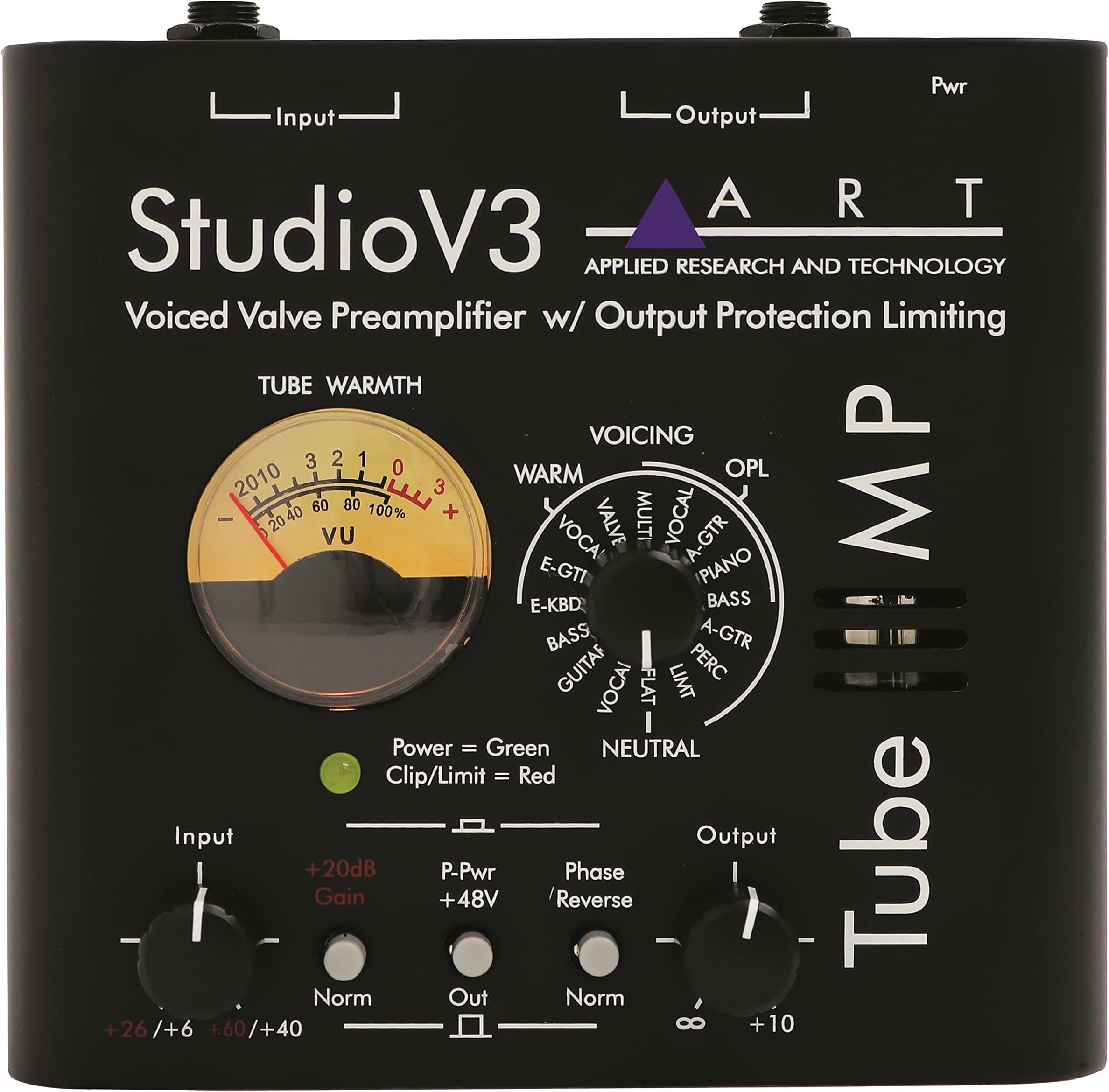
The ART Tube MP Studio V3 is a single-channel tube microphone and instrument preamplifier featuring advanced Variable Valve Voicing technology for tailored tonal presets across multiple instruments. It includes an Output Protection Limiter to safeguard connected equipment from signal peaks, housed in a robust metal chassis with an analog meter and smooth controls. Ideal for professional recording and live sound, it supports XLR connectivity and delivers warm, high-quality audio with reliable performance.
| ASIN | B0002E56IA |
| Amplifier Type | Tube |
| Best Sellers Rank | #27,379 in Musical Instruments ( See Top 100 in Musical Instruments ) #35 in Microphone Preamps |
| Brand | ART |
| Color | Blue |
| Compatible Devices | Guitars (Electric and Acoustic), Keyboards, Bass Guitars, Drums, Vocals |
| Connector Type | XLR |
| Customer Reviews | 4.5 out of 5 stars 525 Reviews |
| Enclosure Material | Metal |
| Global Trade Identification Number | 00840402011446 |
| Item Dimensions D x W x H | 5"D x 5.5"W x 2"H |
| Item Weight | 2 Pounds |
| Manufacturer | ART |
| Material | Metal |
| Mfr Part Number | Tube MP V3 |
| Model Name | ART TubeMPSTV3 |
| Model Number | Tube MP V3 |
| Output Channel Quantity | 1 |
| Output Wattage | 30 Watts |
| Power Source | Corded Electric |
| Product Dimensions | 5"D x 5.5"W x 2"H |
| UPC | 840402011446 |
| Unit Count | 1.0 Count |
| Warranty Description | 2-Year Warranty |
R**R
A Good Basic Preamp with Output Protection Limiting (OPL)
One of the main reasons I choose this later model over the ART Tube MP Studio Original, was for the Output Protection Limiting (or OPL) to protect the hardware I was then connecting this device to, which is an ASUS XONAR Essence STX PCIe card, using it's 1/4" phone Line or Mic Inputs. Using a ten year old standard Radio Shack PA microphone connected via XLR, I can get a crisp microphone sound instead of only getting mostly bass from the cheaper five volt computer electret microphones. RS PA microphone connected via XLR to the ART preamp, and 1/4" balanced phone to the ASUS Xonar STX PCIe card 1/4" Line/Mic combo input. Using no microphone boost, with the microphone input selected within software. For Voice Chat: ART preamp settings: 100% Input Volume, Using +20dB in voice chat, Phase Reverse active, 50% Output Volume with Voice Neutral. Linux or Windows Software settings: Microphone Volume at 100%, with no microphone boost. For Recording: ART preamp settings: 100% Input Volume, +20dB Deactivated, Phase Reverse active, 75% or 100% Output Volume with Voice Neutral. Linux or Windows Software settings: Microphone Volume at 100%, with no microphone boost. NOTE: Above I mentioned I was using the Microphone Input, by selecting the Microphone Input either within the operating system mixer settings or within Audacity. I have since switched from using the Microphone Input, and have now selected the Line Input as the selected recording source, within both the operating system mixer and Audacity. The ASUS Xonar STX PCIe card has combo Line/Microphone inputs, and when the Microphone line is selected, a relay switches/routes the input source through a cheaper electret 5v phantom powered (CMI9780) chip. When switching to Line input, the input source is routed directly through to the Analog to Digital Conversion (or ADC) chip, per RMAA quality reports for SNR benchmarks. Granted, I need to boost both Input and Output volume levels to 100%, including using the +20dB boost for the Line level to be heard. (Perhaps a better mic, which uses phantom +48v might aide here? Shrugs. What does one expect for a Radio Shack generic PA mic? At least it works.) I also purchased an Image Broadcasting Studio Microphone Arm Stand with Shock Mount, alongside my currently owned microphone and desk. Knowing how sensitive computer stuff tends to be, OPL (Output Protection Limiting) is probably worth the extra $40 over the original ART Tube MP Studio Original Mic Preamp. However if you're only performing vocals and no instruments, the Voicing knob will likely always be set at one setting. Pros: 1) Well constructed, with metal casing and rounded edges. 2) My unit included rubber foot pads, for which earlier buyers likely were not given? 3) Reliable analog meter, with a nice vanilla incandescent back light. 4) Good quiet switches and knobs 5) Well labelled, including atop of the unit. No need to lift the device to distinguish rear ports! 6) Conservative blue color. Everything just looks nice. 7) Very quiet. (SNR) 8) Along side my ASUS Xonar Essence STX computer sound card, I can record at a variety of high quality bit rates and sample rates, in comparison of being only limited to the 24-bit/96000Hz of a Focusrite Scarlett 2i2. (I've also seen RMAA benchmarks of the Focusrite Scarlett 2i2 having less quality than the Xonar STX PCIe card, but still might consider the external solution later for recording analog stereo LP's.) 9) Output Protection Limiting, or OPL. 10) Temperature of the unit while powered on for several days is about 94F, while the immediate area of the bulb may register 104F. (Why people exclaim this unit runs hot, can only mean they use the unit somewhere where ambient room temperatures are in excess of 70F.) Cons: 1) No power switch! And the BEST TIP of all, use Audacity and not the Microsoft Windows Sound Recorder! The Microsoft Windows Sound interface tends to mix all incoming and outgoing sound, and the software Sound Recorder tends to make the recordings much more quieter then they really should be. Audacity picks-up where the Microsoft Windows Sound Recorder left-off, and performs a far better job of line/microphone recording! It took me such a long time to figure out why Microsoft's Sound Recorder was performing so poorly, and should only be used for testing or low-quality work. 2013.03.22 - After using this preamp and leaving it on 24/7 for the past week, having some static or line noise issues. Using a XLR plugs from the microphone to the preamp, and XLR to balanced phone to the sound card. I had the preamp near or just underneath a LED display monitor. When I moved the preamp two to three feet away from the computer and about six inches to the right of the LED display monitor, static would significantly decrease. A light static would then increase if I then stood the preamp within a vertical position near the LED display monitor. Chances are, it is very likely I'm seeing RF interference with the LED display from my knowledge of radio frequency interference. I also tried several different cables, disconnecting the microphone, and grounding each piece of equipment with no success. So I'm going on the theory of RF interference and moved the preamp out of the way of the LED display monitor, approximately a foot to the right, and foot and a half down onto a shelf below the desk. Static has further decreased but a slight static does seem to persist, and I'm now also making sure all XLR and phono cabling is running perpendicular across all other computer signal and power cabling. (My gut says it's definitely LED/LCD display RF interference, as this type of interference tends to fade in and fade out, sort of like building-up static. The only sure way of further verifying, moving the microphone and preamp further away from the computer and LED display.) I also just realized I installed a LED light bar a while ago just above my keyboard. Switching this LED light off, the static seems to have ceased, but the static isn't further reproducible after switching this LED light bar back on.
J**A
Almost ten years and this Studio V3 just keeps on running...
I have been doing voice over, podcasting and streaming audio work since 2000 and had this in my original studio in 2009. It has run flawlessly for many years. I left broadcasting for a time in 2012, packed it away and almost forgot about it until I decided to build a new studio this year and after resurrecting it plus replacing the 12AX7 tube with a new Russian model, it is back up and running without missing a beat. I have a deep voice and have done voice over before my streaming career and love any piece of gear that can add even more depth and warmth to my voice and this little blue box does the job. The center rotary switch allows you dial in the tone you would like in a manner similar to an equalizer but with that sound only a tube can give the voice or instruments for you musicians out there. This is a wonderful piece of tech for voice artists like me who just want a simple preamp with these capabilities to match the situation you are in for your vocal work. The unit opens up easily to change out the tube should you need to, but the warranty and instructions specify only a service tech should do this. I think it is a little odd since almost everyone immediately switches out the Chinese no-name brand tubes for the better Russian ones. My only nitpick with this unit is that it doesn't have an off switch, so I have it wired into my studio switched power control center to save the tube from an early grave... All in all, a great piece of kit with an excellent sound and ability to stand the test of time. Thumbs up for my Studio.
L**E
Very interesting device here. Worth a look.
So Amazon sent me a recommendation based on my purchasing history for the ART TubeMPSTV3 Variable Valve Voicing Tube Mic Preamp With Limiter. I read it, thought about it, and I bit. I have a MXL Revelation tube mike that I use for vocals primarily, and it does a great job. It has a tube and puts out that tube sound that some of us like on vocals. I also have box full of Shure Beta 58A mikes, some of which I have been using for 40 plus years. You can drive nails with them and they will still perform. I am used to the vocal quality I get from the Shure mikes. So I thought, hmmm ... I wonder what the Shure would sound like if it was a "tube" mike. Well now I know. The ART arrived with a defective UV meter (which apparently is a recurring problem because I read about them arriving with defective meters in other reviews), but I wanted to test it, so I hooked it up to a Shure mike on a desktop stand right by the mixer. And I have to tell you, that the Shure sounded like a tube mike. I ran at least a dozen tests, five of which were made with the MXL. The Art did not change the sound of the MXL much, but it did the Shure, and I really liked what came through. In fact, I may have liked the Shure through the ART more than the MXL. I will probably order it again and hope that I get one with a functioning VU meter. I did hear some faint buzzing. It does have a reverse-polarity button which helped. But it was sitting on the MXL's control box and I'm confident that some of that came from where the Art was located. It requires a power transformer which is included. Another wire. Another plug. But all in all I think I kind of liked it. I can relegate the MXL to a mike stand. Get it away from my desk. (It has a lot of hardware that goes with it) and use it for vocals with multiple singers. MXL has Omni, Bi, and Cardioid polar patterns and is good for a floor mike. The Shure with the ART will make a great desk mike.
N**N
Much better than expected!
I took a chance buying this, but I’m glad I did. Some reviews indicate that the Art Tube MP V3 is noisy or of low quality, but I found it to be just the opposite. I was able to crank the gain all the way up, including the 20dB boost switch, and get plenty of quiet, clean gain for a Shure SM7B (which is notorious for asking a lot of preamps). It is possible to set this up incorrectly and get noise. It is also possible to get lots of clean, silent gain out of it. Gain staging is important. For best results, run this into the line input of your mixer, recorder, or interface. Use balanced cables where possible. Set the levels with the VU meter at a good level on this preamp, and don’t rely so heavily on cranking the gain on your interface. I was able to get plenty of noise if I turned the Art preamp way down, connected it to my mixer with an unbalanced cable, and turned the gain way up on the mixer. That would make anything noisy though, regardless of price. If you use proper gain staging (as you always should for every signal and component), this thing sounds great. I understand that you can spend a lot more money and get different tube designs that use higher voltages and such. After doing a lot of research into this over the years, I feel that mic preamps are kind of like wine. Once you get to a basic level of quality, most of the differences are quite subtle, especially when operated within normal parameters. But some people will never be happy drinking a $20 bottle of wine, and some people will just never be happy with a lower priced preamp. Be aware that when people talk about preamps on the internet, it’s almost like a religion, or a way to signal that they are Real Professionals Who Know What Real Quality Is And Are Part Of The Club. If you’re on the fence about this, just try it. You’ll probably like it.
L**E
Wonderful recording tool.
EDITED: This is an amazing tool. All it basically does is put a tube in your signal chain. But if you do it right, boy what a huge difference that one tube can make. In one word: warmth. FOR BEST RESULTS: 1. Replace the stock Chinese tube with a Slovakian J/J 12AX7 — this is a noticeable improvement to my ears. 2. Power your signal chain with an isolation transformer. This reduces ground loop hum and makes a huge difference. (Make sure yours has an [800mA * 9vAC] connection.) For live applications (i.e. not running into a mixing board): 3. Run a compressor before the input. For transparency, I prefer an optical type unit like the Mooer Yellow Comp. 4. Run an EQ with active cut/boost after the output. The MXR 10-band EQ works well in this role. To maximize the "warmth" effect of the tube: crank the gain as high as possible without causing signal distortion. So, crank this guy all the way up as high as you can, then cut the gain way down on the Compressor and EQ units on either end. Then fiddle with them — not the preamp itself — to control your final volume. Amazing!! My signal chain looks like this: Instrument -> Moore Yellow Compressor -> ART Studio V3 Preamp -> MXR 10-Band EQ -> ... -> Power Amp. Other thoughts: - The different voicing configurations are noticeably different, presumably making this a very versatile piece of gear (I have not tested this theory myself). - Some reviewers complained the dB meter was not working upon arrival. It is likely that their input signal is probably just too weak. I had thought the same at first, but fortunately I was mistaken. Overall: I'm very happy I chose this unit, now that I have figured out how to configure it; gobs of glorious warmth for only $100, and keep in mind this is with whatever stock tube it shipped with. I will swap in a J/J Slovenian tube and update.
J**R
Extremely powerful and tough
For musical ART literally everything you record with this has the spirit of ART I leave it on 24/7 for many months now still sound's great! have not worn-out preamp tube in 1k+ hours
P**J
The sound of the 1950’s? More or less
In the 1950’s tube and transformer era, bandwidth was limited, distortion was always present, and compressors were more of an automatic gain control with 5-10 second release times. EQ was rudimentary and passive. This little box, believe it or not, more or less does all of that for you today. The Tab V76 tube preamp (aka Abbey Road Red) differed from this circuit in using a higher plate voltage and input and output transformers. They also cost $4000. This circuit uses an opamp and a starved plate tube...the starved plate is less linear, giving more tube distortion in place of the transformer distortion of the original. This is a warmer, fatter 2nd harmonic focus, instead of an edgier 3rd harmonic from the transformer. It’s also much less expensive. The “V3” knob here just cycles through the two EQ’s of the V76: an 80Hz HPF (Lo cut) and a +3dB shelf at 3Khz. None, either/or, and both are given instrument names that you can ignore and do what sounds best. There is also a “Warm” boost setting that gives more distortion, and the “OPL” automatic gain control with a useless 10 second release time but true to the old school opto comps of the 50’s people like to show off in their racks but never use. The LED will stay red for 10 seconds waiting for this to release, the clueless will just yell louder into the unit wondering why the output is so low; I suggest just sticking to the left half of the knob and ignoring the OPL. Finally, the entire signal path has a 6dB/oct LPF (high cut) permanently across it. This makes it sound dark and even warmer, especially countering those bright Chinese condenser mics like the MXL. It’s also true to the sound of the original V76, which was band-limited. It isn’t something I always want for recording though. Still these are cheap and do provide a vintage flavor. People who eke out a living selling the originals will be livid at the suggestion, calling this “toob” etc, but I have provided fair and accurate account of the underlying circuitry. Enjoy.
T**S
This preamp is great...
Once you put a decent 12ax7 or 7025 tube in it. It is a night and day difference. Definitely worth the extra 35 dollars (as of 2023) for a JJ, EHX, Sovtek, etc. tube.
R**Z
Must buy
Get this product instead of spending money on getting a new interface or a new microphone , this costs less than the price of a new good interface or microphone and it greatly improves your recordings. Just keep in mind there’s some white noise when using it , so just use a noise gate.
M**R
Super Teil
Kleiner handlicher Vorverstärker. Ich benutze ihn live auf der Bühne, um einer (billigen) E-Mandoline mit einem sehr leisen Tonabnehmer mehr "Wumms" im Klangbild der Band zu geben. Funktioniert prima, und die Klangregulierung verleiht dem etwas blechernen Klang des Instruments deutlich mehr Wärme.
W**S
Lovely bit of kit
What a great pre amp, before my mic's were dull and quiet, added this and you can make almost anyone sound good, even me! The different settings help you get the right tone for the different venues. Very well made, looks good, performs great. Did I say I liked it?
D**O
Preamplificatore microfono
Esteticamente molto carino. Pesantuccio e bello robusto di metallo. Una volta acceso la valvola si scalda dopo qualche secondo. Il vu meter funziona. Da usare con discrezione perché tende a "colorare" parecchio il suono originale. Le varie varianti di voincing (V3) si sentono parecchio. Buono di conseguenza anche in post produzione per il Mastering di tracce finali
K**O
Art Tube
Excellent. Je recommande
Trustpilot
1 month ago
2 weeks ago