
Desertcart purchases this item on your behalf and handles shipping, customs, and support to KSA.
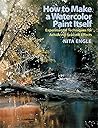
Award-winning artist Nita Engle's breakthrough approach to watercolor shows readers how to combine spontaneity and control to produce glowing, realistic paintings. Her method begins with action-filled exercises that demonstrate how to play with paint, following no rules. Subsequent step-by-step projects add planning to the mix, demonstrating how to turn loose washes into light-filled watercolors with textural effects achieved by spraying, sprinkling, pouring, squirting, or stamping paint. Engle's approach, and her results, are dramatic and dynamic; now watercolor artists can create their own exciting paintings with help from How to Make a Watercolor Paint Itself . Review: Great WC Textbook - Another of my favorite award-winning wc artists. Ever since I saw her work published in a leading wc art magazine many years ago. She presents an unusual starting technique, including colors applied from squirt bottles -- where you wonder whether anything beautiful can come from such chaos, but it does. Her landscapes are readily recognizable but still have a dreamy quality about them, difficult for the artist to effectively pull off, but she does. The different techniques she uses to preserve white spaces is alone worth the price of the book -- together with other unconventional "tools" such as the use of sand and gravel, pine needles and grass, powdered pigments, soap bubbles, heat gun, and similar. As far as some review comments that it is not detailed enough re: steps used to get from start to finish. I have found that virtually any art book on a gallery quality painting comes up short there -- and only attending a workshop or somehow watching an artist from start to finish can supply that insight. But Nita's book gives enough clues to an artist with some experience to allow the trying of several of her techniques successfully. No one, including her, gets it right always -- see her revealing comment on pg 110 "Redesigning a Finished Painting" -- even the masters many times painted their final masterpieces over a previous failed painting. Note too her comments on correcting a composition failing in her painting Island Lake II, pg 105: " ... made a very detailed tracing of the design... After erasing the chalk, I removed some of the paint from the necessary areas with a toothbrush, razor blade, and sandpaper, then washed in the new colors and repainted some darks while the wash was still wet." Corrections, another useful technique Nita discusses. So, for me this book at least is a highly recommended text for the wc artist, no matter what style one paints, and no matter the experience level, provided one can deal with some frustration to gain mastery of a new technique. Review: The bible of the watercolor sceneries drawing ✍🏻 - Very much like the bibles for watercolor artists 👩🎨, I am happy to read the pages. 🎨

| Best Sellers Rank | #53,678 in Books ( See Top 100 in Books ) #59 in Arts & Photography Study & Teaching #68 in Watercolor Painting #217 in Art History & Criticism (Books) |
| Customer Reviews | 4.6 out of 5 stars 1,043 Reviews |
J**N
Great WC Textbook
Another of my favorite award-winning wc artists. Ever since I saw her work published in a leading wc art magazine many years ago. She presents an unusual starting technique, including colors applied from squirt bottles -- where you wonder whether anything beautiful can come from such chaos, but it does. Her landscapes are readily recognizable but still have a dreamy quality about them, difficult for the artist to effectively pull off, but she does. The different techniques she uses to preserve white spaces is alone worth the price of the book -- together with other unconventional "tools" such as the use of sand and gravel, pine needles and grass, powdered pigments, soap bubbles, heat gun, and similar. As far as some review comments that it is not detailed enough re: steps used to get from start to finish. I have found that virtually any art book on a gallery quality painting comes up short there -- and only attending a workshop or somehow watching an artist from start to finish can supply that insight. But Nita's book gives enough clues to an artist with some experience to allow the trying of several of her techniques successfully. No one, including her, gets it right always -- see her revealing comment on pg 110 "Redesigning a Finished Painting" -- even the masters many times painted their final masterpieces over a previous failed painting. Note too her comments on correcting a composition failing in her painting Island Lake II, pg 105: " ... made a very detailed tracing of the design... After erasing the chalk, I removed some of the paint from the necessary areas with a toothbrush, razor blade, and sandpaper, then washed in the new colors and repainted some darks while the wash was still wet." Corrections, another useful technique Nita discusses. So, for me this book at least is a highly recommended text for the wc artist, no matter what style one paints, and no matter the experience level, provided one can deal with some frustration to gain mastery of a new technique.
Y**I
The bible of the watercolor sceneries drawing ✍🏻
Very much like the bibles for watercolor artists 👩🎨, I am happy to read the pages. 🎨
K**.
Wash Techniques for Experienced Watercolorists
I really love this style of painting and found the book inspirational. Unfortunately, Ms. Engle's technique requires a lot of removing paint by erasing, scraping, sanding or whatever, but she doesn't describe these steps in enough detail to follow her process. A video would be more helpful than this book, and I discovered she has several but they are pricey. The first part of the book where she explores the philosophy of creating art helped to focus my mission statement (for lack of a better word). The wash techniques are exciting and produce wonderful, somewhat uncontrolled results. They also use a lot of paint and water and require paper that can handle it. And experimentation. Also, despite the title, the "painting itself" part is only the first step. Once the initial washes are on, the author spends considerable time removing paint and adding details. Chances are, to get similar results, similar effort and extensive experience must also be applied. I'd recommend this book for the concepts presented, but with the caveat that it isn't exactly the detailed instruction in the technique that I'd hoped for.
B**Y
Easy wording
Easy to understand
T**K
Simply the best non-traditional 'how to' watercolour book.
Nita Engle, is brilliant. Not only as an artist, she has the ability to explain her ''non-traditional' techniques in such a way that you do not feel intimidated trying. This is my favourite water colour 'how to' book of all time. if you are seeking flow and freedom in your painting, this book is for you.
J**Y
A great book Fiori watercolour
This book is so well done with great explanations and step by step that I recommend it for beginners and advance artists . It’s better to start watercolour in a loose way than in a tight way ! The author shares all her knowledge which is very rare, so many watercolour books are more a gallery of the author ‘s paintings than given you tips and advices. I definitely recommend this book for every artist.
D**E
wow!
This is a fantastic book for a watercolorist who wants to take it to the next level. I read this cover to cover, dragging the book along with me where ever I went. But I have yet to really experiment and try her techniques. She uses alot of water (and alot of paint?) and explains clearly that her technique depends on the surface she is using- such as illustration board (that slick shiny stuff with the foam core). Note to the wise- this writer is an accomplished artist- her drawing techniques and use of resist are going to be time consuming and intensive- only the flow of paint is quick. But this book certainly gives me a direction to go in. Love it.
S**L
Interesting But
This book is interesting but not sure it is useful for everyone. If you like to paint free and loose then this book will certainly help you. However, if you want more control even in the spontaneous effects of certain techniques this might not be for you. I find more and more my style is a bit more controlled and though I want to be more spontaneous I often am not happy with what results from some of these techniques. I think you need to know what kind of a painter you prefer to be before buying this book. If you are open to happy little accidents and going with the flow, no pun intended, then I think you would enjoy this book. Beautiful artwork and helpful demonstrations. I think some of you will be very happy with this book but for those of you are more methodical in your approach I think you might be disappointed.
G**R
Catturare la luce con l'acquerello!
La prima volta che mi sono imbattuto su una illustrazione di Nita Engle è stato forse 30 anni fa su uno dei libri "condensati" di Selezione, forse qualcuno ne ha ancora memoria. E fu amore a prima vista per la luce che riusciva a imprimere ai suoi acquerelli, oltretutto il digitale era ancora lontano dall'arrivare, quindi indubbiamente erano cose "fatte a mano". Ma il come farle era praticamente impossibile capirlo perchè oltretutto gran parte dei manuali per l'acquerello sono per lo più di impostazione classica, pochi autori "rivelano" i propri trucchi. Altri manuali invece raccolgono una serie di trucchetti che però mai o poche volte vengono finalizzati tanto da restare inutilizzabili. Invece questo libro è certamente tutto quello che avreste voluto sapere per ottenere pazzeschi effetti di luce e texture sui vostri lavori ad acquerello. Nonostante sia scritto in inglese (spero che l'attenta IL CASTELLO ne faccia al più presto una traduzione) è abbastanza comprensibile tante sono le immagini a corredo del testo. I materiali sono tra l'altro abbastanza reperibili anche qui da noi in Italia, altra cosa molto importante per quel che riguarda certi manuali dove gli autori utilizzano cose che si trovano solamente nei loro paesi. Unico neo, la Engle lavora su fogli che difficilmente sono al di sotto dell'A3, il che potrebbe far scoraggiare tutti coloro che non hanno molto spazio a disposizione, ma stimolante è proprio riuscire a fare le sue cose anche in piccolo. Altra cosa, tutte le illustrazioni sono un vero piacere per gli occhi, non sono frutto di dimostrazioni per spiegare le varie tecniche, quindi non aspettatevi la classica immagine "puoi arrivarci anche tu", affatto. Semmai troverete un suo bel lavoro e la spiegazione step by step per arrivare a quel risultato. Insomma, IMPERDIBILE!
L**K
Técnicas de aquarela
Excelente custo benefício!
A**S
Five Stars
i love it
I**K
Terrific!
Terrific book full of wonderful hints, tips, and advice from the writer.
L**C
Ein super inspirierendes Buch
Ein super inspirierendes Buch - Ich würde es nicht gerade als Anfängerbuch empfehlen (da gibt es andere die besser sind) aber dieses ist absolut empfehlenswert.
Trustpilot
1 month ago
3 weeks ago