


Desertcart purchases this item on your behalf and handles shipping, customs, and support to KSA.
🔆 Elevate your photography game—capture moments others only dream of!
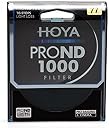
The Hoya 77mm Pro ND 1000 Filter is a premium neutral density filter that reduces light by 10 stops, enabling wider apertures and slower shutter speeds for creative control. Featuring Hoya’s ACCU-ND coating, it maintains true-to-life color balance without color shifts. Its low-profile aluminium frame minimizes vignetting, making it ideal for portrait and long-exposure photography. Trusted by over 1,600 photographers with a 4.6-star rating, it offers professional-grade performance at an accessible price point.


| ASIN | B00HF6HJFG |
| Audio Recording | No |
| Best Sellers Rank | 55 in Photography Grey Filters |
| Box Contents | Hoya 77 mm Pro ND 1000 Filter |
| Brand | Hoya |
| Brand Name | Hoya |
| Coating Description | ACCU-ND |
| Coating description | ACCU-ND |
| Colour | Black |
| Compatible Devices | Cameras with 77mm lens size |
| Customer Reviews | 4.6 out of 5 stars 1,637 Reviews |
| Enclosure Material | Aluminium |
| Global Trade Identification Number | 00024066057341 |
| Has Self-Timer | No |
| Item Dimensions L x W | 7.7L x 7.7W centimetres |
| Item Type Name | Neutral density filter for camera. |
| Item Weight | 1 Grams |
| Light Sensitivity | 10 stops |
| Manufacturer | Hoya |
| Manufacturer Part Number | YPND100077 |
| Material | Aluminium |
| Maximum Shutter Speed | 30 seconds |
| Media Type | ProductImage |
| Model Name | 77mm PROND ND 1000 Neutral Density Filter |
| Model Number | YPND100077 |
| Number of Items | 1 |
| Number of Pieces | 1 |
| Photo Filter Effect Type | Neutral Density |
| Photo Filter Factor | 1024 x |
| Photo Filter Size | 77 Millimeters |
| Photo Filter Thread Size | 77 Millimetres |
| Photo filter effect type | Neutral Density |
| Photo filter thread size | 77 Millimetres |
| Set Name | Hoya 77mm PROND ND 1000 Neutral Density Filter Set |
| UPC | 024066057341 |
| Unit Count | 1.0 count |
| Water Resistance Level | Not Water Resistant |
| Water resistance level | Not Water Resistant |
J**.
Good value; Extremely Neutral Color
Review of Hoya ProND1000 Neutral density filter: - Hoya ProND1000 is a 10 stop filter. I measure 10.3 stops in the green channel - Hoya ProND1000 is *extremely* color-neutral: A very small red cast is measurable, but not visually obvious (more below). - No discernible Infra-Red leakage / IR pollution. - Typical, decent quality aluminium frame. - Good price for performance. Safety: This is NOT a filter for photographing the sun. ========================================== - If you want to photograph the sun, use only a filter designed and certified for photographing the sun. - Solar filters have heavy IR and UV reduction, as well as high attenuation of visible light, to prevent damage to eyes or equipment. - Contact your local astronomy society, or university astronomy department for advice. Colour: ====== I've attached images of a ColorChecker chart, with: 1) Hoya ProND1000 filter 2) No filter 3) SRB ND1000 filter - These were all taken with a fixed "UniWB" white balance, which gives all images a strong green cast (the point of this weird white balance is to make it easier to check RAW exposure). - The filtered images were taken at 6", f/4. The unfiltered image was taken at 1/200 ", f/4. - The loss of focus in the filtered images is down to my sloppy technique with an extending zoom lens, the short object distance to the colour chart (~0.6m), and the wide-ish aperture (f/4). The lack of sharpness should not be attributed to the filters. The Hoya ProND 1000 is very neutral. Under Halogen lighting, I measure a very small red cast: Red up by 1.5%; Blue down by 0.25% (relative to green). The measured cast varies a little with lighting. If you are worried about this level of color cast, you should also be worrying about the color casts introduced by changing lenses. These shifts were measured on Nikon D7200 using RAW - i.e. linear light - data extracted using RawDigger. In comparison, It's quite clear that the SRB ND1000 has a blue cast. On the Nikon D7200 I used, Blue is up by about +20%, Red is down by about 30%. But the color shifts are fairly even across the different patches, so white balancing, either by setting a custom WB in the camera with the filter attached, or by adjusting the color temperature in RAW processing. The SRB has just a little difficulty with the lime-green patch on the third row, which is (relative to other patches) shifted slightly to yellow. The colour shifts quoted were measured under halogen lighting. I get similar results under high-quality (CRI Ra 98; CQS 95) LED lighting [Philips ExpertColor 4000K]. Construction: ============= Decent aluminium construction. Brass, with a knurled ring for better grip would be ideal (Like Breakthrough Technology X4 filters). Sharpness & visual artefacts: ============================= I have seen images ProND1000 images with halo artefacts perhaps related to reflections between sensor and filter. On Nikon D7200, I haven't been able to reproduce such artefacts: I've tried photographing lights, shining a torch at the filter out of frame. I've also seen reports of sharpness problems with the Hoya. But pixel-peeking with and without the filter shows *I*'m getting very sharp images, with no significant loss of detail, even inspecting images at 200%. I'm not aware of vignetting problems, except with Nikon 10-24 at 10mm at the extreme (<100 pixels) frame corners, which are down ~1/3 EV - seems like filter ring shading. I'm mostly using the Hoya with Nikon D7200 and Sigma 17-50 f/2.8 OS, at near 50mm and f/5-f/8. Usage: ===== - Autofocus may - or may not - be possible with a 10-stop filter fitted to your camera, depending on your camera, and available light. Some experimentation with live-view autofocus, and, for DSLRs, with TTL phase-detect auto-focus, is required. TTL phase-detect auto-focus may work well, but the problem is it may be hard-to-impossible to see what you are focussing on, because of the dark viewfinder relative to your environment. - A typical technique is to focus the camera without the filter, either manually, or with autofocus, and then attach the filter. Some care is required, particularly with extending zoom lenses, not to upset focus. Plate filters in a filter holder are better in this respect. There is a small focus shift on adding a filter, but negligible except for macro photography: the focus point will shift away from the camera by roughly 1/3 of the thickness of the filter glass - typically less than 1mm. - Possible difficulties in focussing suggest the use of small (ish) apertures to ensure adequate sharpness: say f/11 (full-frame); f/8 (APS-C); f/5.6 (Four Thirds). Significantly smaller apertures (higher f-numbers) will cause a loss of sharpness due to diffraction. - On SLRs, use the viewfinder blanking plate to prevent stray light entering the camera via the viewfinder. With a 10-stop filter, not much stray light needs to enter the camera to ruin a photograph. If you've lost the one that came with your camera, inexpensive 3rd-party replacements are available for popular camera models. On some camera models, you may get away without the blanking plate. I have tried and failed to provoke my D7200 to misbehave when using a 10-stop filter - for example by shining a 1.5W single-LED torch into the viewfinder. - Fitting *any* filter increases the likelihood of ghosting and flaring: Use a lens hood or matte-box to shade the filter and lens from stray light. Alternatives: ============= SRB ND1000: Moderate, correctable, blue cast; similar construction; half the price (roughly). Breakthrough Technology X4 Neutral Density 3.0: [I haven't tried this] Fairly neutral; low vignetting; Excellent construction; double the price (at least).
B**S
Great ND 1000 filter for its price.
I have bought the Hoya 49mm Pro ND 1000 filter. It is just great for my Sony a7 camera and Zeiss 35mm f/2.8 lens. Hoya produces the best value for money ND filters. The ND 1000 is the darkest neutral density filter for 49 mm filter thread. It's ideal for long exposure shooting. Like in the case of creating light rays from car lamps during night. Or vanishing people and cars from photos during daylight by using 30 seconds long exposure. It is isn't truly neutral density. It changes a little the colors. Not big issue for amateurs like me. That is unavoidable with affordable ND filters. It isn't a professional ND filter as its name suggests. Professional ND filters costs at least five times more. For its money it's great thought. The reflections are truly negligible. Very good anti reflecting coating. This something I like with all Hoya filters. I have problems to clean the filter with my lenspen. I don't know why. The box of the filter could be better. It is heavier than the filter, it doesn't close safely. I combine the filter with another Infrared filter and shoot directly the sun with telephoto lens for sun spots.
L**N
Good first ND filter
First ND filter that I ever bought and I'm glad I did. Gives lovely results and is cheaper than the 100x100mm square filters. PROS - Relatively good value for money - Good quality - Case that it comes in does a good job of protecting the filter and is nice and small. CONS - It is quite wide and although it can be used with other filters I have experienced some vignetting when stacking up. - Not great if you want to use it with lots of different lenses with different filter thread diameters All in all I would recommend buying this if you are just starting out with long exposures and don't think you'll be using many other filters. If you think you are going to be using ND grads and polarisers I would consider looking at the likes of NiSi's or Formatt Hi-Techs square filter systems.
D**E
Excellent so far.
Recently taken delivery of this. On a 700d crop sensor camera I can use the filter on a 77mm thread canon 24-70 and (with a 77-67mm adapter ring) a 67mm thread canon 10-18mm stm lens without any vignetting / obstruction at all. I'm sure other lenses will be the same. The ability to use the filter with the 10-18mm stm lens really surprised me as 67mm filters screwed direct to the lens are visible in shot at the 10mm end and vignette to varying degrees at the narrower angles. I've had a good look at the images today and the shift in colour balance (when using Auto White Balance) is minimal to negligible (in the conditions the camera appeared to render slight inconsistent / different results in AWB mode whether the filter was fitted or not and so this may have been due to the camera and conditions). When selecting the White Balance either on a custom or one of the presets (I used Cloudy and direct sunlight) the difference in colour shift with / without the filter was negligible if noticeable at all. This was backed up by the camera's RGB histograms when reviewing the images. Also, reviewing the images at 100% zoom there was neglible, if any, change in sharpness in the images with / without the filter that I could see. In the conditions tested I would say use of the filter resulted in a difference of between 11 to 12 stops according to my 700d depending upon the composition of each shot. I still have concerns over the longevity of the surface treatment on the lens given other reviews I've read however for now I'm going to give it five stars. Having used other ND filters of varying qualities I'm v. happy with this thus far and would recommend buying it.
R**T
Excellent colour reproduction without loss in sharpness and without vignetting
Used with the Nikon D800, Nikon 24-70/2.8 and Nikon 70-200/4 (with a step up ring) the Hoya Pro ND 1000 and Hoya Pro ND 64 filters work very well. They give sharp pictures with very good colour and no extra optical vignetting (ND filters from other brands do give optical vignetting because they consist of dark glass, while the Hoya Pro ND filters have a metal coating which gives an even light distribution). I measure the exposure and white balance with an UV filter on or without filter and then set exposure and white balance to manual (using WB presets) and compensate the exposure when the ND 1000 filter is mounted. The white balance needs a B4 compensation for this filter, so at least on my setup it gives a bit of warmth unless you correct it, but that is easily corrected in camera and the difference is consistent so that I can always use the same WB compensation (B4) after having measured the WB for a specific scene. I measure the exposure and white balance with an UV filter on or without filter and then set exposure and white balance to manual (using WB presets) and compensate the exposure when the ND 64 filter is mounted. The white balance consistently needs no compensation for this filter. Edit: I have noticed that in many cases AWB works fine with the Hoya Pro ND 1000 or Hoya Pro ND 64 filter mounted (also when mounted together). This means that it is usually enough to set the exposure manually while letting AWB set the WB. You can stack filters, which I do with the Hoya 77mm Pro ND 1000, Hoya 77mm Pro ND 64 and the B+W 702 77mm 25 Percent MRC Graduated Neutral Density filter. The same WB compensation is then achieved (i.e. the ND 1000 and ND 64 filters themselves are not affected with regards to WB, and so no additional compensation is needed as long as the other filters are neutral). I stack the ND 1000 and the ND 64 and if needed I stack the GND in front of the ND filter/s. Note that you do get mechanical vignetting from the stacking so that I can use 24 mm focal length with one filter, 28 mm with two filters and 35 mm with three filters with no visible vignetting from the filters. When it comes to cleaning, the Hoya Pro ND 1000 and Hoya Pro ND 64 are a bit more difficult to clean compared to the B+W MRC filters. It means that a microfiber cloth is normally the only thing you need, but if you put a finger print on the glass, you will need to use B+W filter cleaning solution to make it come off, which has not yet been the case for me with the B+W MRC filters. To sum it up the Hoya PRO ND filters are currently the best money can buy with excellent colour reproduction, without loss in sharpness and without vignetting. Highly recommended.
R**B
Great filter and speedy delivery
Having bought Hoya products in the past, I was hopeful this filter would be of a similar high quality and I haven't been disappointed. The filter certainly seems to cut out plenty of light (I haven't tested if it is the full 10 stops or not), and having taken some test shots there doesn't appear to be any loss in picture quality or any colour cast. The filter is easy to attach & remove and feels very well made as I've come to expect from Hoya products. My only small niggle is that if using this filter with another (such as a polarising filter), then at 16mm you do get a little bit of vignetting on the photo. When up to about 18mm this isn't a problem and obviously it's fine if it's the only screw-in filter being used. As for delivery, Amazon once again have been great - well packaged and on time, so no problems at all. Overall, very pleased with the filter and would definitely recommend.
T**M
Great filter and worth every penny
Great filter and worth every penny. Unlike other 10 stop neutral density filters, this one does not leave a colour cast. Experienced hands will know this but for those who are trying this for the first time, you will need an exposure chart to work out how long you need to open the shutter for. You will need to take a reading with your camera's meter and then reference the chart which tells you how long to expose it for. You then set this up on your camera using the manual settings option and hey presto! Some experimentation may be necessary to get it just right for your particular camera but as I have said, it produces great results.
G**K
Great 10 stop filter, with no visible colour cast.
A few years ago, I bought a B+W 10-stop filter in preparation for a landscape photography course I was due to attend. Every single image (used on a Canon 5D) had an awful purple colour cast, which kind of ruined my appetite for long exposure photography. I now have a Fuji X-T10 and decided to take the plunge with this Hoya 10-stop filter, in readiness for a coastal holiday. Having used it, I'm very impressed. The resulting images had no visible colour cast and were as sharp as if there'd been no filter in place. It's not especially cheap, but I suppose you get what you pay for. I purchased the 52mm version.
C**.
"LE" filtre idéal pour la photo pose longue!!!
Fidèle à eux même Amazon sont les meilleurs pour avoir tout les articles et en moins de 72h à domicile.
E**R
Graufilterfotografie
Der 1000er Filter ist einerseits eine krasse Verdunkelung andererseits notwendig, wenn man schöne weiche Wasserfälle oder glatte Seen ablichten möchte. Ein Stativ ist dabei nicht nur von Nutzen sondern ein Muss. Die Qualität dieses Filters, von mir mit 72mm erworben, ist sehr gut, sowohl optisch als auch mechanisch. Den Filter kann ich uneingeschränkt empfehlen. Inwieweit man auf weniger als 1000 zurückgreift hängt vom Effekt ab, den man insgesamt erzielen möchte. Es muss schon sehr hell sein, damit man mit aufgeschraubtem Filter im Sucher einer DSLR noch etwas sieht was man zum Einstellen verwenden kann. Oft wird das im Blindflug erledigt, bzw. anhand des Resultats, da man meist mehrere Minuten belichten muß. Eine Hilfe kann dabei die Einstellung bei Offenblende sein, während man zur eigentlichen Aufnahme ja eher die geschlossene Blende wählt. Geduld und Zeit sind hier gefragt und meist mehrere Versuche. Das Ergebnis ist es aber wert.
V**T
Hoya value for money..!
Very good filter and its effective in the sunlight. worth the value... You won';t regret
M**R
good product.
Works great have to experiment with it a bit more.
B**R
Amazing quality
One of my best purchase from Amazon till date. This Hoya ND1000 produces impeccable and stunning images. No vignette, no colour shift.....absolutely loving it. Moreover, made in Japan, this filter built quality is excellent. My best wishes to the seller.
Trustpilot
4 days ago
2 months ago