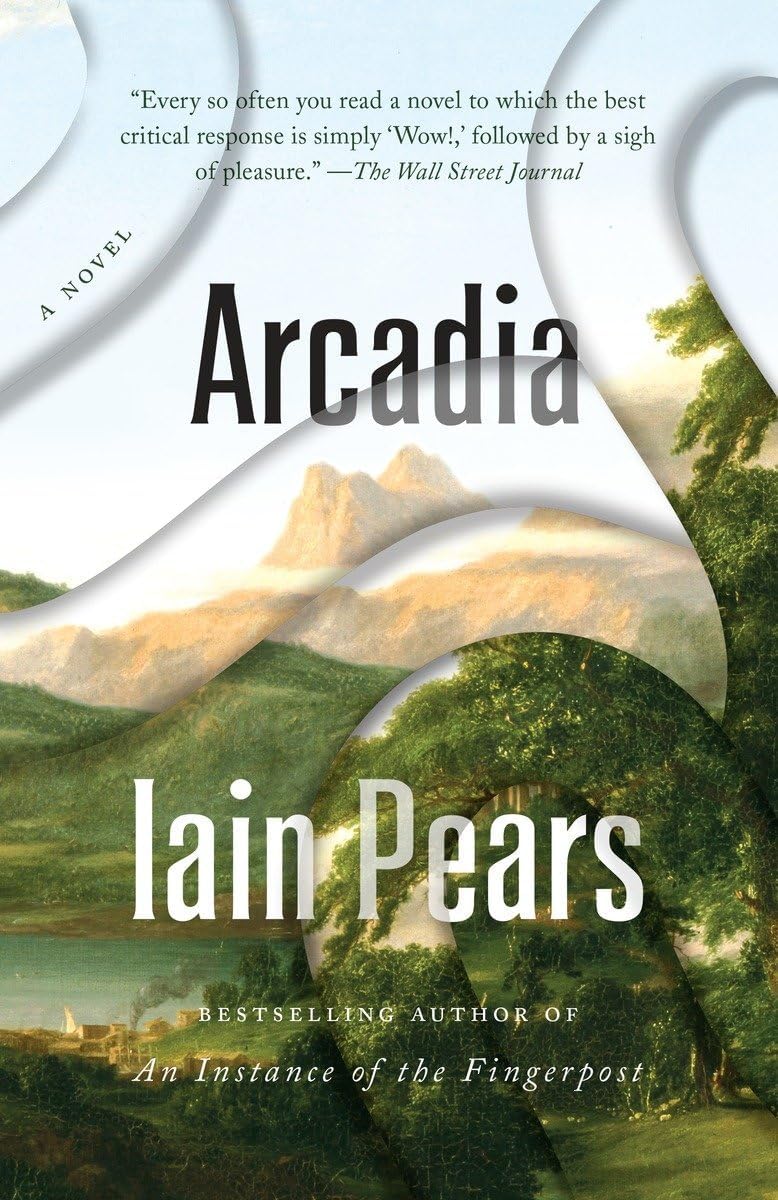
Arcadia
Product ID: 43212020
Desertcart purchases this item on your behalf and handles shipping, customs, and support to KSA.
desertcart.com: Arcadia: 9781101970836: Pears, Iain: Books Review: Very well done story. Not to be missed by readers looking for an intelligent story - I may be Iain Pears biggest fan. I haven't finished Arcadia yet but as I perused the reviews I felt compelled to write my review now after reading some of the comments from other reviewers. This story, much like An Instance of the Fingerpost is told in a unique, creative way. This book, much like Fingerpost, must be read in as few sittings as possible. If you read some then put it down for a week then pick it up again you will most likely lose track of the characters and get confused and bored. That happened to me with Fingerpost so I started it over and read it in a few days. Arcadia has many of the same type of subtleties so you must have reading discipline to get full enjoyment and understanding of the story. Stones Fall was another great book but not as complex. Great descriptive writing. Arcadia is witty, entertaining, and funny at times and.it is also interesting and refreshing given that many of the authors I used to enjoy just keep writing books with the same story over and over again. I understand some of the other comments and concerns about the alternate world reading more like a young adult novel. It sort of is but it seems to fit the whole story. There is no sex or profanity at all. I would hand this book over to my kids and let them have at it. It is written so cleverly, so witty at times I laughed out loud. The main character, Angela, was interesting, intellectual with an attitude and I enjoyed reading her parts which are the only written in first person. It was a little difficult to keep the timelines straight but that did not take away from my enjoyment. I simply loved this book and wish there would be a sequel. Anything Iain Pears writes I will read. Review: Quirky, smart, fun time and dimension hopping story - This was a really good book combining the twin genres of time-travel stories (like Twelve Monkeys or Back to the Future) and "entrance into another world" stories (like Narnia, Alice in Wonderland, or The Magicians). It can get a little confusing with all of the time- and place-hopping, but it was smart, and funny, and even a little philosophical. I give it a good recommendation for fans of those twin genres, and would generally recommend just about anything Pears writes. This quirky book by Pears generally follows stories in three times/locales: (1) a vague time some 250 years in the future when society is ruled by warring factions of capitalist scientific elites thinking only about technological progress, with an underbelly of rebels who eschew technology in favor of studying and preserving the knowledge of the past; (2) pre- and post-World War II England and France, when the threats of Fascism and Communism invade all aspects of society, including what should have been the safe haven of literary academia; and (3) a completely separate world of swords and horses created from the mind of a professor in the literary academic life of timeline (2), who has good ideas that aren't fully fleshed out and who tends towards laziness in correcting some of those shortcomings, which results in the world of his creation acting on its own to fill in the gaps. When people from the first timeline become able to cross into the second and third, a truly mind-bending series of events ensues. Pears is known for books that occur in multiple points of history, but most of his other works deal with investigations in the modern world that have historical links shown through flashbacks; in Arcadia, however, what happens in one timeline has material changes for the present(s) in the other timelines, and some of the characters physically jump from one to the other, with often hilarious results. Angela Meerson, a brilliant scientist from timeline (1) with a penchant for stimulants and mind-altering substances, both creates the machine allowing the transfers and seems to befriend or befuddle just about every other character in the book. Henry Lytten, a professor of literature in timeline (2) and an aspiring writer with a history of working for and with England's intelligence services, is the absent-minded professor whose scribblings somehow form an actual world in timeline (3). Rosie, a precocious teenager who has befriended Henry in timeline (2) somehow finds her way into timeline (3), causing all sorts of upheaval with her strange ways, especially to Jay, a young boy from timeline (3) who is prophesied to play some major role in his world's history. Meanwhile, both the scientific establishment and their security apparatus in timeline (1) send their own investigators into timelines (2) and (3), with the expected confusion of both the time-travelers and the people they encounter. The plot is smart, funny, and confusing in the best ways. It makes some satirical, yet profound, statements about each society, with obvious comparisons to our own modern world. I can't say that I was totally pleased with the ending, as not all of the subplots were wrapped up neatly, but it was a fun time- and dimension-hopping ride while the read lasted. Despite an infuriating British tendency to have completely diametrically opposed views from me with respect to comma usage, and the habit to overuse "try and" (instead of "try to"), Pears's writing is solid in most aspects. He's equally adept at literary prose, satirical banter, and 1940s teenager slang, so once I suspended my comma-induced ire, I truly enjoyed the mechanics of this read. I give this a solid recommendation for fans of satirical time-travel and fish-out-of-water stories, as well as books involving dystopian futures and alternate realms.
| Best Sellers Rank | #940,016 in Books ( See Top 100 in Books ) #5,464 in Science Fiction Crime & Mystery #6,873 in Literary Fiction (Books) #10,611 in Action & Adventure Fantasy (Books) |
| Customer Reviews | 4.3 out of 5 stars 1,329 Reviews |
R**F
Very well done story. Not to be missed by readers looking for an intelligent story
I may be Iain Pears biggest fan. I haven't finished Arcadia yet but as I perused the reviews I felt compelled to write my review now after reading some of the comments from other reviewers. This story, much like An Instance of the Fingerpost is told in a unique, creative way. This book, much like Fingerpost, must be read in as few sittings as possible. If you read some then put it down for a week then pick it up again you will most likely lose track of the characters and get confused and bored. That happened to me with Fingerpost so I started it over and read it in a few days. Arcadia has many of the same type of subtleties so you must have reading discipline to get full enjoyment and understanding of the story. Stones Fall was another great book but not as complex. Great descriptive writing. Arcadia is witty, entertaining, and funny at times and.it is also interesting and refreshing given that many of the authors I used to enjoy just keep writing books with the same story over and over again. I understand some of the other comments and concerns about the alternate world reading more like a young adult novel. It sort of is but it seems to fit the whole story. There is no sex or profanity at all. I would hand this book over to my kids and let them have at it. It is written so cleverly, so witty at times I laughed out loud. The main character, Angela, was interesting, intellectual with an attitude and I enjoyed reading her parts which are the only written in first person. It was a little difficult to keep the timelines straight but that did not take away from my enjoyment. I simply loved this book and wish there would be a sequel. Anything Iain Pears writes I will read.
R**S
Quirky, smart, fun time and dimension hopping story
This was a really good book combining the twin genres of time-travel stories (like Twelve Monkeys or Back to the Future) and "entrance into another world" stories (like Narnia, Alice in Wonderland, or The Magicians). It can get a little confusing with all of the time- and place-hopping, but it was smart, and funny, and even a little philosophical. I give it a good recommendation for fans of those twin genres, and would generally recommend just about anything Pears writes. This quirky book by Pears generally follows stories in three times/locales: (1) a vague time some 250 years in the future when society is ruled by warring factions of capitalist scientific elites thinking only about technological progress, with an underbelly of rebels who eschew technology in favor of studying and preserving the knowledge of the past; (2) pre- and post-World War II England and France, when the threats of Fascism and Communism invade all aspects of society, including what should have been the safe haven of literary academia; and (3) a completely separate world of swords and horses created from the mind of a professor in the literary academic life of timeline (2), who has good ideas that aren't fully fleshed out and who tends towards laziness in correcting some of those shortcomings, which results in the world of his creation acting on its own to fill in the gaps. When people from the first timeline become able to cross into the second and third, a truly mind-bending series of events ensues. Pears is known for books that occur in multiple points of history, but most of his other works deal with investigations in the modern world that have historical links shown through flashbacks; in Arcadia, however, what happens in one timeline has material changes for the present(s) in the other timelines, and some of the characters physically jump from one to the other, with often hilarious results. Angela Meerson, a brilliant scientist from timeline (1) with a penchant for stimulants and mind-altering substances, both creates the machine allowing the transfers and seems to befriend or befuddle just about every other character in the book. Henry Lytten, a professor of literature in timeline (2) and an aspiring writer with a history of working for and with England's intelligence services, is the absent-minded professor whose scribblings somehow form an actual world in timeline (3). Rosie, a precocious teenager who has befriended Henry in timeline (2) somehow finds her way into timeline (3), causing all sorts of upheaval with her strange ways, especially to Jay, a young boy from timeline (3) who is prophesied to play some major role in his world's history. Meanwhile, both the scientific establishment and their security apparatus in timeline (1) send their own investigators into timelines (2) and (3), with the expected confusion of both the time-travelers and the people they encounter. The plot is smart, funny, and confusing in the best ways. It makes some satirical, yet profound, statements about each society, with obvious comparisons to our own modern world. I can't say that I was totally pleased with the ending, as not all of the subplots were wrapped up neatly, but it was a fun time- and dimension-hopping ride while the read lasted. Despite an infuriating British tendency to have completely diametrically opposed views from me with respect to comma usage, and the habit to overuse "try and" (instead of "try to"), Pears's writing is solid in most aspects. He's equally adept at literary prose, satirical banter, and 1940s teenager slang, so once I suspended my comma-induced ire, I truly enjoyed the mechanics of this read. I give this a solid recommendation for fans of satirical time-travel and fish-out-of-water stories, as well as books involving dystopian futures and alternate realms.
S**B
Favorite book of 2016 so far
It's a masterpiece. 1) This is the first book of Pears' I've read. Some other reviewers thought it paled in comparison to his others, namely An Instance of the Fingerpost , but I was mesmerized from beginning to end. 2) In terms of storytelling, its three storylines/genres (Anterwold (fantasy) 1960s Britain (historical/literary fiction), and dystopia Mull (sci-fi)), are each absorbing, well-plotted, and beautifully interleaved. The book is more than 600 pages and I wished it were longer. 3) Some hardcore fans of speculative fiction may not be as impressed as I was. Fans of David Mitchell should be impressed, I think. I love David Mitchell, but in my opinion Pears has him beat when it comes to pushing the limits of the form. He made an accompanying app that allows you to read the storylines in your own preferred order, for heaven's sake. 4) That said, I didn't use the app. I was never a fan of the Choose Your Own Adventure books. I'm not a gamer, nor a fan of collaborative art. I prefer to slip into someone else's vision entirely. While it was challenging at times to follow, it wasn't that hard and if I could follow, SF fans could easily follow. Pears reiterated (via dialogue) the points that were confusing until they became clear, though the effect was never (in my view) labored. 5) I LOVED it. I also enjoy Tolkien, Lewis, Huxley, Michael Ende's The Neverending Story, Orwell, all the classic genre examples. Perhaps it was the reviewers who are bored by these classic writing styles who didn't find the book edgy enough.
E**N
Unique
Arcadia is a strange melange of sci fi, futuristic dystopia, medieval fantasy, cold war spy novel, murder mystery and Shakespearean romantic comedy (part of the story is clearly inspired by As You Like It). The story takes place in three time periods (though it is not clear until the end which is past, present and future) with what seem to be three distinct storylines, until they start to interact through multiple characters traveling through time. The science is explained, but is clearly not meant to be taken too seriously -- rather, the time travel is a means to propel an extremely complex plot and allows some meditation on how the past affects the future. Some of the plot involves amazing coincidence, but that seems to be part of desired Shakespearean affect. While the plot is dense, the tone throughout much of the book is breezy, comic, funny -- the effect is somewhat like a souffle that is light as air but is clearly the product of a master chef. Pears manages to tie up his many loose threads. Bravo.
T**5
Inkling Insipid
Although cleverly plotted, this novel targets the YA market (or even adventurous younger readers) much more than it will engage adult readers who may have enjoyed either Pears' sophisticated art fraud mysteries or his philosophical magnum opus, The Instance of the Fingerpost. Although this tale offers some provocative speculations about time travel, the multiverse, and the tangibility of fictional creation, none move to a maturity other than that of a clever idea reasonably well expressed Also, as the novel reaches its climax, the characters themselves begin to lose coherence, with the result that the ending (or, perhaps more accurately, the frantic tidying up of the narrative) felt rushed, inconclusive and somewhat disconnected, almost as if Pears had grown bored with his creations and couldn't wait to leave them behind. This novel thus continues, at least for me, the disappointing trend in Pears' more recent fiction, where execution falls far short of the author's intellectual ambition.
R**T
The parts are better than the whole.
This is the fourth novel of Iain Pears I have read. I found "An Incident at the Finger Post," "The Dream of Scipio," and "Stone’s Fall" engaging and looked forward to "Arcadia." I found "Arcadia" a bit of a chore and not nearly as enjoyable as the previous three. "Arcadia" is a magic box of interlocking and symbiotic stories in which characters recur in sometimes slightly different forms in a series of alternative worlds. It’s kind of like Italo Calvino meets Luigi Pirandello. The idea at "Arcadia’s "narrative core is the ultimate unknowability of reality, and the ways in which subjective and objective perception bedevil attempts to understand who and what and where we are. The various stories that Pears creates to pursue this theme are sometimes interesting, and some of his characters are captivating. Rosie Wilson, for example, is a fifteen-year-old girl who is the beating heart of the stories. Inspired by Shakespeare’s Rosalind in "As You Like It," she brought to my mind Lewis Carrol’s Alice, and some of her adventures are reminiscent of Alice’s. But the playfulness of Alice’s adventures is missing here. Pears is not into word play. His side game is literary allusion, which has its own pleasures. He also occasionally toggles back and forth from third- to first-person narratives, but I can’t complain about that as I have done the same in my novel "Romance with Variations" (yes, you may find my novel and its sequel here in Amazonia). Any novel that features time machines, corporate villains, an Oxford don with back story in the cloak-and-dagger world of espionage, a medieval-like kingdom with wandering bards and forest bandits that is ruled by a queen sometimes reminiscent of Britain’s Gloriana, and the pert and precocious (sometimes too much so) Rosie Wilson has its undeniable pleasures. But be forewarned: "Arcadia "is not an easy narrative (or series of narratives) to assimilate. You’ll want to keep a list of characters before you and make sure the cat doesn’t keep jumping in your lap while you are trying to penetrate the coil of worlds Pears has created. Finally, a humorous footnote. In assembling my list of characters to make sense of Pears’s thickly populated worlds I took a side trip with our current omniscient and omnipresent god, Mr. AI. Mr. AI assured me that a group of characters that nowhere appear in "Arcadia" was in fact there. Wrong, Mr. AI. Lady Croom, Septimus Hodge, Thomasine Coverly, et al., are in Tom Stoppard’s play "Arcadia, "not Iain Pears’s novel of the same title. So watch out who you hang out with!
P**H
A decent story with a satisfying ending
I took interest in this book after hearing how it was uniquely arranged and dealt with multiple genres that appealed to me. Considering the book isn't out in the US, (aside from the app), until February 2016, I decided on importing the hardcover version. Anyhow, to sum up the book quickly; it's basically a time travel story meets The Chronicles of Narnia with bits and pieces of other stories thrown in; and told in a way similar to how David Mitchell tends to do, jumping between many characters and times. I don't know whether to lean more toward it being more like Mitchell's "Cloud Atlas", (at least in form like the film adaptation, where it jumped around), or more like Heinlein's "All You Zombies", with the way things kind of skewed in form, but could be untangled by the end. I'm not the world's best reviewer, and I really prefer to not spoil the book for anyone who still has yet to read it. Basically, I'd say to give the book a chance. I enjoyed it, and I'm very picky about what I read. The author in the book points out that his Anterworld development, (a story in progress for him), borrows from other stories, and tells them in a "better way". In a way, the very book you're reading, Arcadia, does this. The way the whole thing wraps up is pretty ingenious as well, and is one of the rare cases I didn't feel cheated at the end, or thought "It should have been X instead". Not the best thing I've ever read. Not even the best thing I've read this year. But, good enough. I was going to give the book 4 stars, but the way the book ended being thoroughly satisfying got that extra star from me.
K**S
One of the best books I've read in the recent past
One of the best books I've read in the recent past. As far as time travel books go, this ranks up there with A Wrinkle in Time, The Time Traveler's Wife, 11.22.63, Replay, Time on My Hands, and of course, Time and Again. In many ways, it's better than all of them combined: More complex - though easy to follow. More thoughtful and literary - though presenting many new and interesting ideas and parallels, and some great surprises. The author is very engaging; all the pieces fit together and it's rather epic in scope with great pacing and superior structure. Also, fascinating explanation of the effects of time travel which support the story line(s). I loved every minute of reading it and I didn't want it to end. I could go on, but If you have a kindle, read the other positive reviews, download the sample, and see for yourself!
Trustpilot
2 months ago
1 day ago