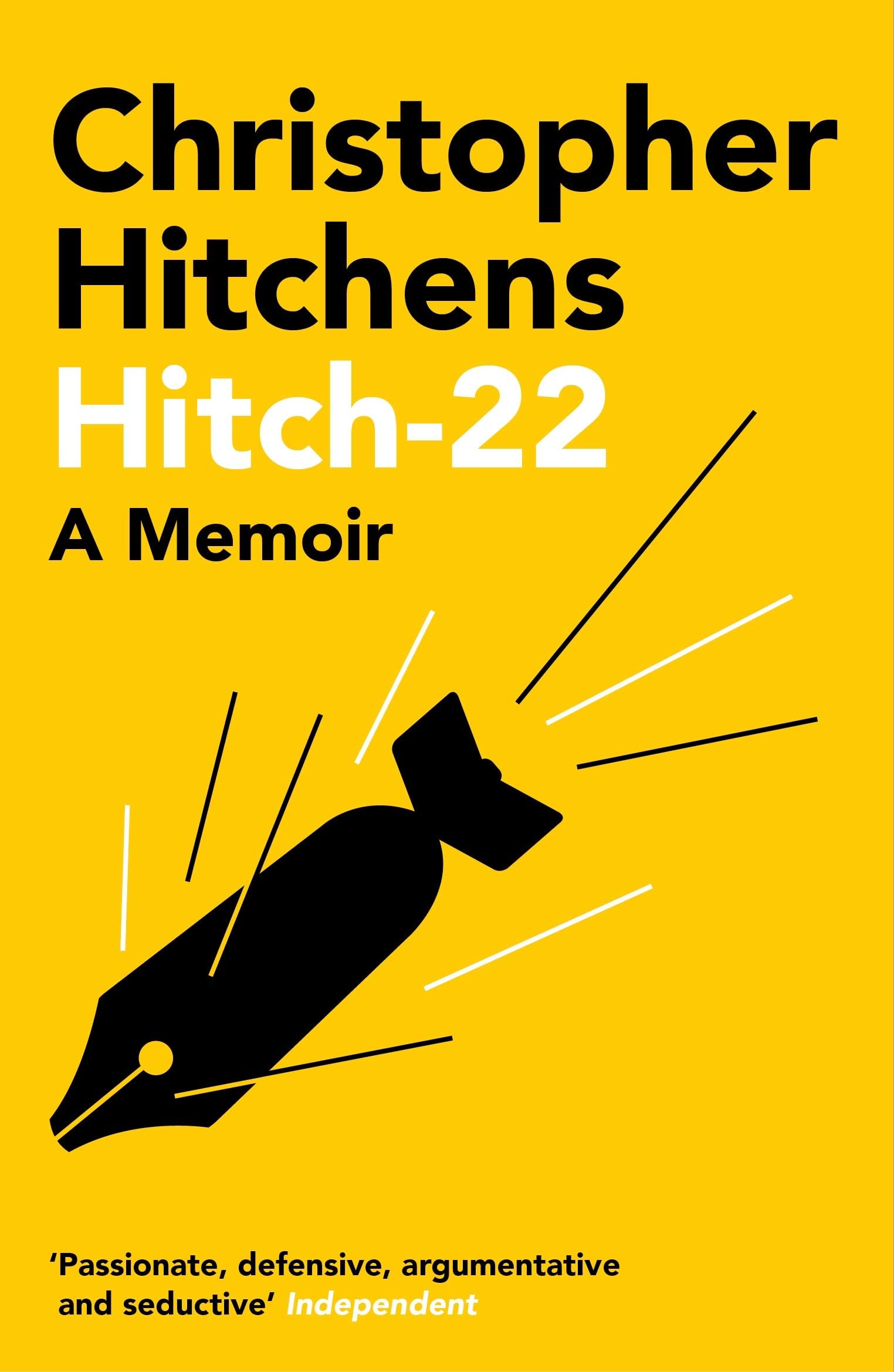
Hitch 22: A Memoir
Product ID: 347412214
Desertcart purchases this item on your behalf and handles shipping, customs, and support to KSA.
Nominated for the National Book Critics Circle Award In this long-awaited and candid memoir, Hitchens re-traces the footsteps of his life to date, from his childhood in Portsmouth, with his adoring, tragic mother and reserved Naval officer father; to his life in Washington DC, the base from which from he would launch fierce attacks on tyranny of all kinds. Along the way, he recalls the girls, boys and booze; the friendships and the feuds; the grand struggles and lost causes; and the mistakes and misgivings that have characterised his life. Hitch-22 is, by turns, moving and funny, charming and infuriating, enraging and inspiring. It is an indispensable companion to the life and thought of our pre-eminent political writer. Review: Hitch is my life - Hitch is my life. My struggle, my existence are all about fighting against organized religions and all reli bullies toward mankind. Hitch is my life. I think you don't need any more words about the book. ☺❤✨ Review: Hitch - If you are buying this book you know Christopher hitchens , but this book will give you a deeper insight into his life and mind

| Best Sellers Rank | #189,045 in Books ( See Top 100 in Books ) #6,493 in Biographies & Autobiographies (Books) |
| Customer Reviews | 4.5 out of 5 stars 2,075 Reviews |
P**U
Hitch is my life
Hitch is my life. My struggle, my existence are all about fighting against organized religions and all reli bullies toward mankind. Hitch is my life. I think you don't need any more words about the book. ☺❤✨
V**I
Hitch
If you are buying this book you know Christopher hitchens , but this book will give you a deeper insight into his life and mind
N**X
Hitchens is Hitchens!
If you have taken this book then you must be a Hitchen fan or Hitchenian! Try it once if you are not!
S**V
I love it
Must read .
K**A
Expected better of Hitchens
A very solipsistic autobiography
B**C
Unless you are a Hitchens fan don't but it. ...
Unless you are a Hitchens fan don't buy it. Well written and took me a long time to read as I perused it looking up words and facts as I went along. Most references are incomprehensible due to a lack of understanding of western history. An utterly rivetting read if you are a voracious reader.
G**V
Charged wrong amound
charged INR 850 for the item that is of INR 550
P**R
Good read
Good read Awesome book Good quality print and paper
L**I
Bellissimo, inaspettatamente
L'interessante vita dell'autore, raccontata in modo piacevolissimo,con una scrittura esemplare.Non mi turba, pur essendo io convinto credente,l'ateismo di Barnes, che me lo fa apprezzare anzi di piu' perche', al di la' della sua vita particolare, lo definiresti "una brava persona".
T**S
A Former Trotskyite Reflects on his Life in America and around the World
Christopher Hitchens, once the "enfant terrible" of the international hard left, has written a memorable memoir, HITCH-22, that is at once pretentious, bombastic, self indulgent, sometimes petulant -- and often brilliant. Much in Hitchens' book is laugh out loud funny as he takes one pot shot after another at his old political allies and enemies. And for someone with Hitchens' wit and writing facility, taking down his enemies with the written word is like shooting the proverbial fish in a barrel. On a more serious note, Hitchens explains how he transformed himself from a London-based Trotskyite commentator into an American immigrant who defends of the allied invasion of Iraq. In fact, Hitchens presents us with a quite sensible defense of George W. Bush's war on terror in both Iraq and Afghanistan. This is not an easy book to read, mainly because Hitchens writes in a style that makes clever use of inverted grammer and five and six syllable words as he reaches into his psyche to explain himself. Morever, his views are strongly held, and he doesn't suffer fools with any sympathy for their alleged pigheadedness. On the other hand, this book is a very good read for those who are trying to cope in a world that seems to be spiraling out of control. Hitchens opens his memoir with a short family history - which may explain a lot about his cynical view of the world. His father was a quite common British Navy officer, while his mother was an immigrant Jew with Polish/Germanic blood. His mother ultimately meets s a tragic fate, while his father lives out his routine life without a clue to the torment of his wife or the intellectual pretensions of his son. Hitchens was educated at Oxford, where he is exposed to the leftist tendencies of that venerable institution, and he became a self-proclaimed Trotskyite member of the communist party. In his early days, the Vietnam War was the focus of his activism, and he joined the anti-war movement that denigrated capitalistic America. But his intellectual curiosity was too restless for the static Marxist view of the world, and as he witnesses events in eastern Europe, the Middle East and elsewhere, he begins to develop empathy for the free enterprise system that empowers America. The turning point for Hitchens came on Sept. 11, 2001. The terrorist attacks on lower Manhattan and the Pentagon, costing some 3,000 lives (most of them American) was a revelation for Hitchens. "Before the close of that day, I had deliberately violated the rule that one ought not to let the sun set on one's anger, and had sworn a sort of oath to remain coldly furious until these hateful forces had been brought to a most strict and merciless account." So Hitchens began to write about the hatefulness of the Islamist jihadists, defending America against those who felt "the chickens had come home to roost." `I did not intend to be told, I said, that the people of the United States - who included all those toiling in the Pentagon as well as all those, citizens and non-citizens, who had been immolated in Manhattan - had in any sense deserved this or brought it upon themselves," Hitchens writes. "I also tried to give a name to the mirthless, medieval, death-obsessed barbarism that had so brazenly unmasked itself. It was, I said, 'Fascism with an Islamic Face'." When he decides to become an American, he studies diligently for the citizenship test and passes, of course, with flying colors (Hitchens is a serious student of American history as evidenced by his book, "Thomas Jefferson: Author of America"). By that time he had become an ardent supporter of the incursion into Iraq and he was sworn in at the Jefferson Memorial by Homeland Security Chief Michael Chertoff (talk about clout). His fondness for America, however, does not extend to American presidents and other national leaders: Lyndon Johnson ("hideous); Richard Nixon ("running a parallel regime of bagmen and wiretappers behind the façade of a legitimate government); Jimmy Carter ("..pious, born again creep); Ronald Reagan ("the carapace of geniality proved to be flaky...the look of senile, shifty malice); George H.W. Bush ("I simply detested the way in which he lied his way as Vice President through the Iran-contra scandal.."); Bill Clinton ("habitual and professional liar"); Curiously, George W. Bush escapes the Hitchen scorn. In an earlier volume ("The Trial of Henry Kissinger," published in 2001) Hitchens developed a full-scale criminal indictment of Henry Kissinger (whom Hitchens describes as"indescribably loathsome" in his memoir) for his conduct of American foreign policy. In the final chapters of his book, Hitchens shifts the focus to himself. He comes across as a gadfly, of course, but also a wary, skeptical (sometimes cynical) observer of our times whose professional objectives include intense scrutiny of all that is evil in our world. In an effort to explain himself further, Hitchens fashions for himself a Proustian survey in which his answers are supposed to give us insight into his persona. What we get is a portrait of a conflicted intellectual who takes pride in his knowledge and experiences, but whose most "marked characteristic" is insecurity. He most dislikes stupidity, according to his self-imposed questionnaire, and he most admires both moral and physical courage. His favorite virtue is an appreciation for irony. It was with a sense of irony then, when Hitchens was approaching 50 years of age, that his younger brother, Peter, discovers that their mother was Jewish, raising the intriguing possibility that they both are Jewish. A self-proclaimed atheist (see his book, "god is Not Great: How Religion Poisons Everything"), Hitchens considers, but rejects the prospect of his Jewishness. In doing so, he reveals his contempt for Zionist Israel and its occupation of Palestinian lands. But his awareness of his Jewishness increases his sympathy for the suffering of the "children of Israel" as they seek a homeland. His confliction over his roots thus gives him valuable insights to the current Middle East stalemate between Israeli Zionists and Islam jihadists. Hitchens is clearly sympathetic to the Palestinian movement, but he also thinks that the Jewish people have a right to seek their own identity, preferably somewhere else than on Palestinian soil. Hitchens illuminates his agony over this dilemma by describing the deterioration of his relationship with his good friend Edward Said, a Palestinian intellectual. Hitchens and Said initially developed a very close relationship, but after Sept. 11, 2001, according to Hitchens, Said started writing anti-American essays and articles, and their relationship started to cool. The relationship was effectively destroyed when Said quoted, without attribution, commentary by Hitchens that he (Said) said was "racist." There could be no greater insult to Hitchens than to be called a racist. He never spoke to Said again. HITCH-22 is a very good memoir -- it is topical, penetrating, amusing and revealing -- one that is well worth the time and effort to read. The memoir offers an insightful look into the mindset of one of our era's most astute social and political critics. Postscript: shortly after his memoir was published in the spring of 2010, Hitchens was diagnosed with cancer of the esophagus that had metastasized into his lung and lymph nodes. He underwent chemotherapy and wrote in the September issue of Vanity Fair: "I am quietly resolved to resist bodily as best I can..."
P**P
Hitchens on sparkling form
In this bio you feel you get to know Christopher Hitchens the man; not just what he thinks about things, but why. His describes himself as easily bored, but his life has been anything but boring, not least because of his determination to take himself into places where people are oppressed and where there is an element of danger. I've always respected his intellectual rigour, but I had not been aware of just how far he'd ventured into dangerous situations to see for himself the conditions under which people in countries such as Iraq, Bosnia and Argentina were living. His account of friendships with James Fenton, Martin Amis, Salman Rushdie and Edward Said are full of warmth and make me want to read more of those authors. The one thing I found very strange, though, was the absence of women in the book. Yes, they flit in and out, but, apart from Hitch's mother, they barely feature other than as asides until, quite late in the book, we get to mentions of Ayaan Hirsi Ali and Susan Sontag, both regarded as admirable and brave. Girlfriends and a wife are mentioned, just: I was particularly struck by one girlfriend who had purchased Greyhound bus tickets so that she and Hitch could travel around the US, but who is never heard of again after arriving with the tickets. She's not named and, like other girlfriends, seems to have made precious little impression on Hitch. Did they split up? Or was she a continuing but negligible presence? The only accounts of love in the book are with male friends: Hitch is frank and amusing about his early relationships in an all-male boarding school, and regards himself as heterosexual. He's clearly capable of extraordinarily deep and loving relationships - with men. So I am now puzzled. Does the omission of women as formative influences mean that he really doesn't 'get' women, except as sexual partners? Or is this deliberate omission to spare wounding people with whom he's had relationships? If the latter, I'd have expected him to say so. Anyhow, to this reader, the paucity of intellectual relationships and friendships with women comes across as a gaping hole in a life that is otherwise full of interest. But don't let that put you off the book: it is varied, gripping and an excellent account of a well-examined life. I read as kindle e-book, and found the ability to scroll to unfamiliar words for a dictionary definition very useful: I regard myself as having a large vocabulary, but the dictionary was nevertheless needed occasionally. However, sometimes the defeat was created by misspellings: the kindle version has not been carefully proof-read, and there's an odd tendency for e to trasmute into m from time to time.
T**X
Brilliant book, obviously, but the type setting ...
So, this is a great book, a masterpiece even, and this rating by no means reflects Hitchens' mastery of language, philosophy and wit. Rather, it's the typesetting that was used by the publisher. 'The text height is sub-millimeter!' (exclaimed the Man-Karen). I don't need text the size of The Green Caterpillar, but reading text this small severely detracted from the enjoyment of reading this otherwise brilliant book. Such a pity.
D**H
This book is great
Hitchens' style is amazing – he can use big words and talk about complex themes without ever making it boring or off-putting. Great memoir, highly recommended.
Trustpilot
1 month ago
5 days ago