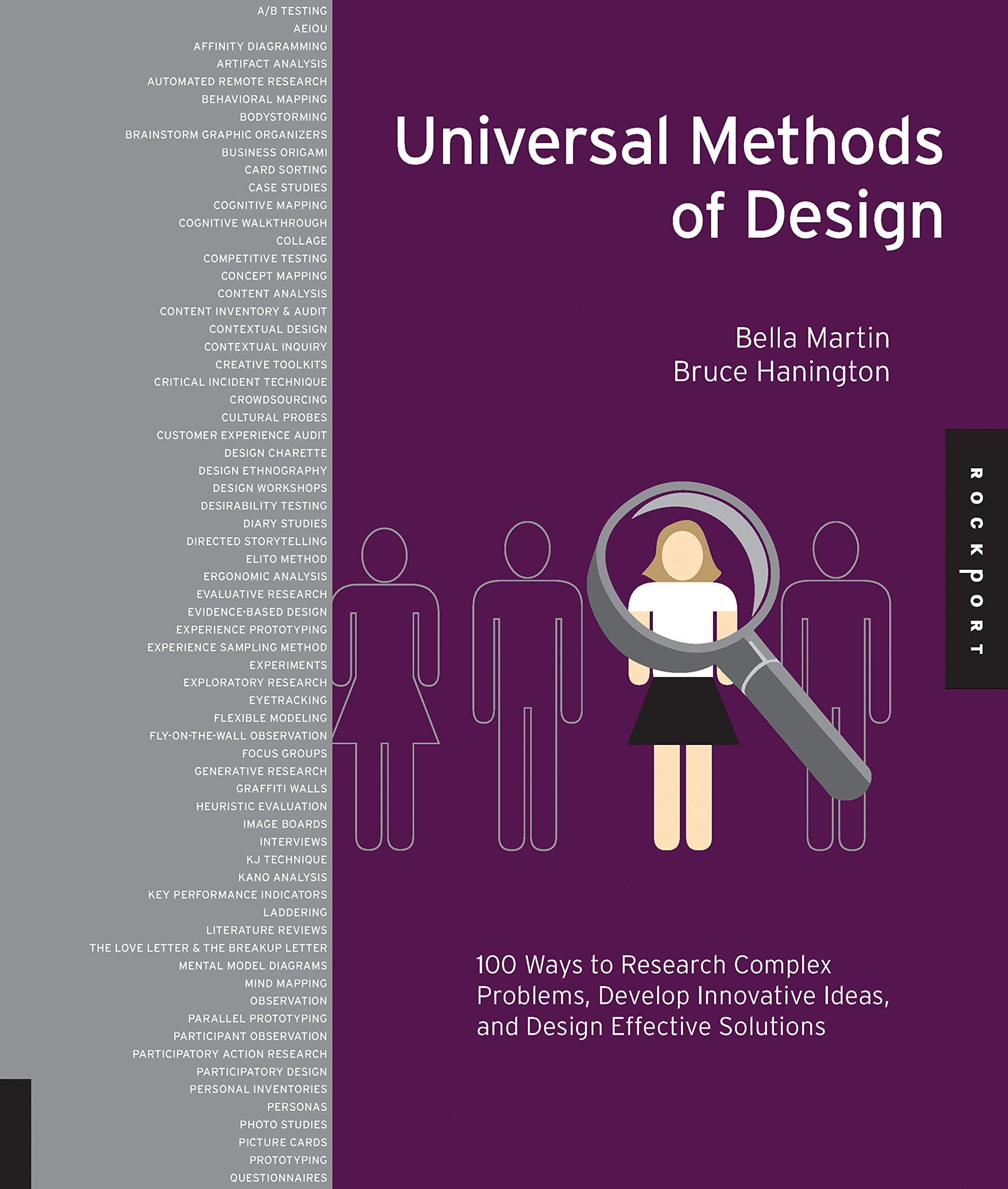
Universal Methods of Design: 100 Ways to Research Complex Problems, Develop Innovative Ideas, and Design Effective Solutions
Product ID: 3450664
Desertcart purchases this item on your behalf and handles shipping, customs, and support to KSA.
This comprehensive reference provides a thorough and critical presentation of 100 research methods, synthesis/analysis techniques, and research deliverables for human centered design, delivered in a concise and accessible format perfect for designers, educators, and students. Universal Methods of Design serves as an invaluable compendium of methods that can be easily referenced and used by cross-disciplinary teams in nearly any design project. Methods and techniques are organized alphabetically for ongoing, quick reference. Each method is presented in a two-page format. The left-hand page contains a concise description of the method , accompanied by references for further reading . On the right-hand page, images and cases studies for each method are presented visually. The relevant phases for design application are highlighted as numbered icons along the right side of the page, from phases 1 (planning) through 5 (launch and monitor). Build more meaningful products with these methods and more: A/B Testing, Affinity Diagramming, Behavioral Mapping, Bodystorming, Contextual Design, Critical Incident Technique, Directed Storytelling, Flexible Modeling, Image Boards, Graffiti Walls, Heuristic Evaluation, Parallel Prototyping, Simulation Exercises, Touchstone Tours, and Weighted Matrix. This essential guide: Dismantles the myth that user research methods are complicated, expensive, and time-consuming Creates a shared meaning for cross-disciplinary design teams Illustrates methods with compelling visualizations and case studies Characterizes each method at a glance Indicates when methods are best employed to help prioritize appropriate design research strategies Universal Methods of Design is an essential resource for designers of all levels and specializations. Review: A good Introduction and synthesis to design methods - This book has a similar format of Universal Principles of Design, but in this case, is a compendium of methods. It has 100 design research methods, sometimes are analysis techniques or research deliverables that constitutes some of what people call design thinking. In the book you will find design research methods that could be exploratory, secondary, generative or evaluative. I think is a good synthesis especially if you want to learn how to do the design work that in a lot of books is just ethereal. But if you really want to implement a specific method perhaps you will need another source for deeper understanding. In most of the methods you will find the sources for more information, and sometimes the seminal publication of the method. It also presents suggestions of complementary methods inside the book in a "see also" line. I liked the format of the book because is easy to read and to use as a guide: it has just two pages per method, one small description and an example. The book helped me a lot gaining a big picture of design methods. A must have for someone who wants to get deeper in the design research. Review: Great overview; great design, but tiny gray type. - Overall this is a gorgeous & well-organized book of design/usability research techniques, presented alphabetically as well as with numeric hints indicating which are best suited to different phases of a project. I'm really looking fwd to reading the rest of the techniques once I locate a magnifying glass ;) This is a nice hardcover book with an attractive, modern design that presents the one quibble I have so far: I find the text too small & too light, making it very hard to read. The body text is only maybe 8-9pt, and is light-middle gray in color. On white pages it is tiring to look at, and the amount of whitespace on many pages indicates they probably could've bumped up the font size juuust a tad. I had to hold the book practically up to my nose to read the first few pages (I'm early 30s & have 20/20 vision). On the whole it's an attractive design & would be a great ebook, but for the sake of legibility and usability (ironically...) it might be better w larger, darker type. The magnifying glass on the cover may actually be a suggestion. Still, the quality is great & so is the content thus far - just having to work for it a bit too much.


| Best Sellers Rank | #200,594 in Books ( See Top 100 in Books ) #378 in Graphic Design Techniques #1,203 in Design & Decorative Arts |
| Customer Reviews | 4.5 out of 5 stars 263 Reviews |
F**C
A good Introduction and synthesis to design methods
This book has a similar format of Universal Principles of Design, but in this case, is a compendium of methods. It has 100 design research methods, sometimes are analysis techniques or research deliverables that constitutes some of what people call design thinking. In the book you will find design research methods that could be exploratory, secondary, generative or evaluative. I think is a good synthesis especially if you want to learn how to do the design work that in a lot of books is just ethereal. But if you really want to implement a specific method perhaps you will need another source for deeper understanding. In most of the methods you will find the sources for more information, and sometimes the seminal publication of the method. It also presents suggestions of complementary methods inside the book in a "see also" line. I liked the format of the book because is easy to read and to use as a guide: it has just two pages per method, one small description and an example. The book helped me a lot gaining a big picture of design methods. A must have for someone who wants to get deeper in the design research.
M**1
Great overview; great design, but tiny gray type.
Overall this is a gorgeous & well-organized book of design/usability research techniques, presented alphabetically as well as with numeric hints indicating which are best suited to different phases of a project. I'm really looking fwd to reading the rest of the techniques once I locate a magnifying glass ;) This is a nice hardcover book with an attractive, modern design that presents the one quibble I have so far: I find the text too small & too light, making it very hard to read. The body text is only maybe 8-9pt, and is light-middle gray in color. On white pages it is tiring to look at, and the amount of whitespace on many pages indicates they probably could've bumped up the font size juuust a tad. I had to hold the book practically up to my nose to read the first few pages (I'm early 30s & have 20/20 vision). On the whole it's an attractive design & would be a great ebook, but for the sake of legibility and usability (ironically...) it might be better w larger, darker type. The magnifying glass on the cover may actually be a suggestion. Still, the quality is great & so is the content thus far - just having to work for it a bit too much.
A**.
A permanent addition to my book collection
Need this for my ongoing graduate studies and I love this book. There are no "oh great filler" pages, it gets straight to the point, it's not so big that you're cursing out the physical dimensions of the book, and works great with sticky notes. And truly there are so many choices for research methods, you're going to want sticky notes. The author does a wonderful job at describing those methods too, so you're not staring at a wall going, "what did I just read?"
A**N
Indispensable
As a user experience designer with 10 years of experience and clients like National Geographic, Stephen Hawking, Best Buy, Bon Iver, and Harvard University, I have experience with nearly every method described in this book. Yet when I pack up to go to work or consulting gigs or client meetings or lectures or workshops, this is the first book that goes into my bag before I leave home. When I'm not carrying it with me it is usually still close at hand. There are many more inspiring, industry-changing texts on the market, but Universal Methods of Design is simply the most valuable book in my day-to-day practice. I thought of saying that this book is to user-centered designers what Strunk's Elements of Style is to writers, but the analogy isn't quite right. Writers generally know the best practices for semicolon usage and unordered list formatting. In contrast, most people that claim the title "user experience designer" still spend the majority of their time wireframing or designing in Photoshop. It's really not your fault, it is ours; the UX community has done very little to help educate entering UX professionals, so you have likely never been exposed to most of the methods detailed in this text. You don't know how powerful a simple technique like Affinity Mapping can be, or how the investment in LEGO's Serious Play products can yield a hundred-fold return, or how an absurd hour spent writing love letters and hate letters to yourself can significantly improve a product. But for the aspiring UX designer, this book is an essential introduction to the methods used in professional experience design projects. For those of us that have experience with these design methods: we all have dealt with those challenging projects, difficult stakeholders, or unique product requirements that seem to exhaust our standard design toolbox. Those situations where our usual methods for scoping, defining, researching, modeling, prototyping, producing, and testing seem inadequate. In these situations, there is no better reference than what Hanington and Martin have put together in this book. Buy it, and if you are underwhelmed then I'll buy you a drink and let you hassle me about it when I see you at the next conference.
C**S
I recommend it to beginner designers and just all designers really
An essential collection of design research and design methods! I didn't think this book would be handy but throughout the semester I found myself looking back at it for ideas on how to go about my projects. I recommend it to beginner designers and just all designers really! The layout of the book and each method was very easy to understand!
A**B
An anthology of design research to keep as a handy reference
This book is a reference to 100 different, but many times interconnected methods of design research. Although it doesn’t go into a deep analysis of each method, it provides a description and reading references, should the reader want to explore things further. I often found that looking at the images at the end of each section first, and then reading the main text, provided me with a better understanding of the material. All in all a not-so-easy-to-read book, but rich in content nonetheless.
M**O
A Current, Comprehensive Survey of Best Practices in Design Research Methodology
This is a reference book and a survey book, of one hundred current methods in design research methodology, for the fitting of a product, service or system to a user, client or customer population. The survey and the text are the product of the superb learning and research environment for these methods at Carnegie Mellon University. Methods are listed in alphabetic order. Each is given a two page treatment; one page of text and another of figures and diagram. URLs, standard reference sources are conveniently listed on the same page, and not in an index at the back of the text. The treatment of these diverse methods in identical format makes a cross comparison of methods simple and fast. Further, an indication is given (an index of 1 through 5) of whether the method is useful at the early or the late phases of the research process so that methods can be compared within phase-catagories. The format and page layout in the hard-copy version are such that moving between methods, and cross comparing methods will be easier in the paper format than in the electronic. At the bargain price of 24 USD this is both an affordable and very complete aid to current best practices in design survey methodology.
P**K
excellent material.
If you are hitting road blocks in your design process, I HIGHLY recommend this book. I don't like the set up of the table of contents only because it wasn't very clear and I always flip to the wrong page (it shows the design method number and page number right next to each other). But the content is really good and it helps me a lot!
F**I
useful as a reference
It was useful for my phd research thesis.
B**R
Schöne und hilfreiche Sammlung
Dieses Buch enthält eine viele Methoden für die verschiedenen Phasen des Gestaltungsprozess - unabhänig davon, welchen Prozess oder Ansatz man denn nun gewählt hat. Es ist eine lose Sammlung und kein Methodenbaukasten. Keine der vorgestellten Methoden und Maßnahmen wird den erfahrenen Gestalter überraschen, doch stellt das Buch eine sehr pragmatische Übersicht bereit und hilft es auch seltener genutztes wieder in Erinnerung zu rufen. Für Anfänger eher ungeeignet, da die Methoden zwar vorgestellt werden, aber nicht mit einer detaillierten Prozessbeschreibung oder Vorlagen bereitgestellt werden. Es dürfte für unerfahrene auch schwer sein, für den jeweiligen Anwendungsfall die richtige Methode zu wählen. Für erfahrene Designer, Design Manager, Product Owner, etc.pp. ist dieses Buch aber extrem hilfreich im Alltag und sollte immer griffbereit liegen.
A**N
Great reference book for any designer
Great reference book for any designer for understanding different techniques for design research. This book has very simple format, one page has a short description and the other has visual context and example...
F**E
Must have for a designer
Manuale che raccoglie e formalizza 100 metodologie e tecniche di approccio al Design e alla ricerca. Assolutamente da avere. Consigliato per Junior e Senior designer, project managers e team interdisciplinari.
A**T
This is a great, easy to understand book for
I'm a former design engineering student now working in UX, and I had my first copy of this book stolen from me. This is a great, easy to understand book for designers
Trustpilot
4 days ago
3 weeks ago