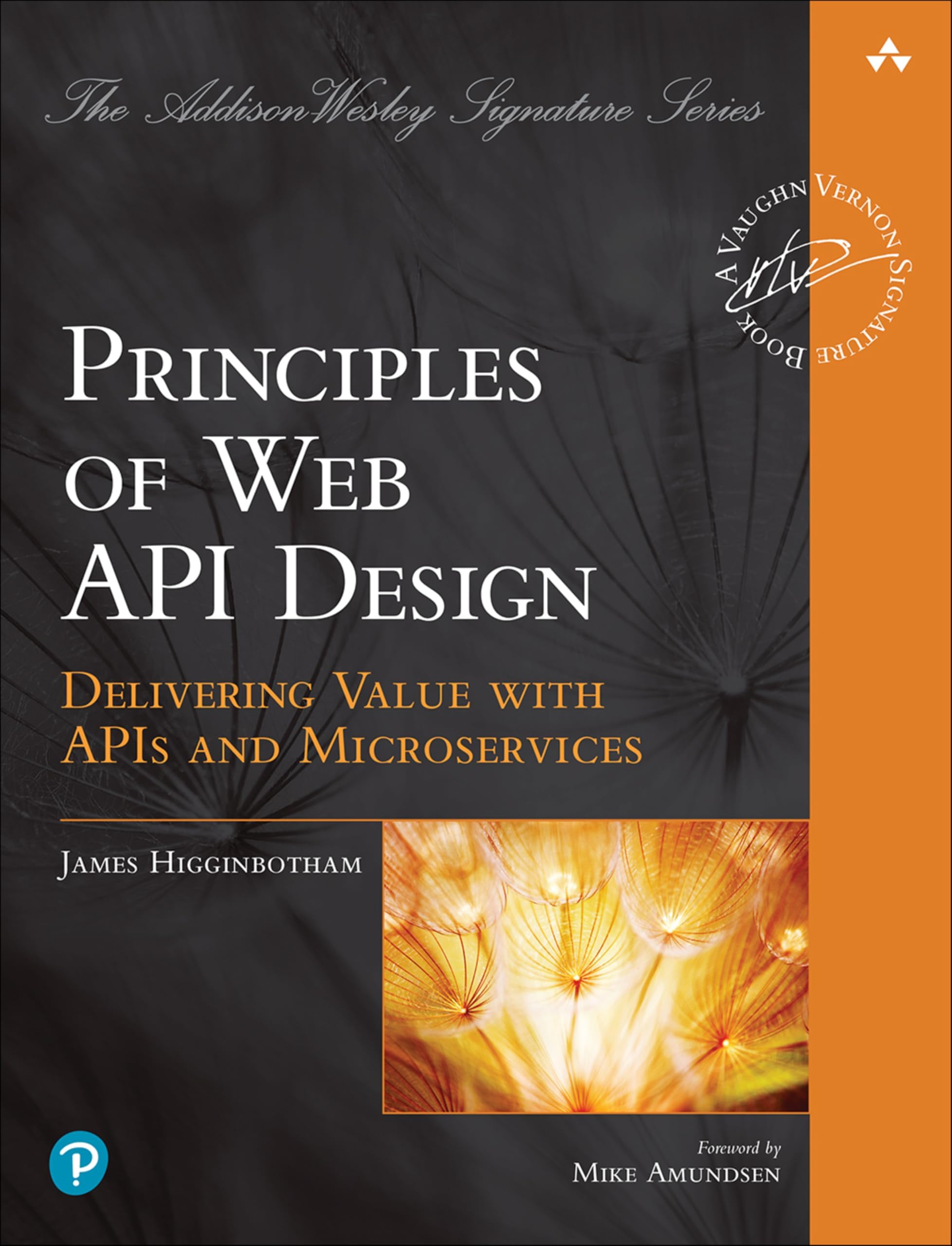
Principles of Web API Design
Product ID: 320256707
Buy anything from 5,000+ international stores. One checkout price. No surprise fees. Join 2M+ shoppers on Desertcart.
Desertcart purchases this item on your behalf and handles shipping, customs, and support to KSA.
The Full-Lifecycle Guide to API Design Principles of Web API Design brings together principles and processes to help you succeed across the entire API design lifecycle. Drawing on extensive in-the-trenches experience, leading consultant James Higginbotham helps you align every stakeholder on specific outcomes, design APIs that deliver value, and scale the design process from small teams to the entire organization. Higginbotham helps you bring an "outside-in" perspective to API design to reflect the voices of customers and product teams, map requirements to specific and well-organized APIs, and choose the right API style for writing them. He walks through a real-world example from the ground up, offering guidance for anyone designing new APIs or extending existing APIs. Deliver great APIs by getting your design processes right Gain agreement on specific outcomes from design teams, customers, and other stakeholders Craft job stories, conduct EventStorming, and model capabilities Identify the right APIs, and organize operations into coherent API profiles Choose the best styles for each project: REST, gRPC, GraphQL, or event-based async APIs Refine designs based on feedback from documenters, testers, and customers Decompose APIs into microservices Mature your API program, implementing design and management processes that scale This guide is invaluable for anyone involved in planning or building APIs--architects, developers, team leaders, managers in single and multi-team environments, and any technical or business professional delivering "API-as-a-product" offerings. Register your book for convenient access to downloads, updates, and/or corrections as they become available. See inside book for details. Review: Full of practical tips on API design - In this book, James has given us the gems he learned from his experience working with many companies and teams. This book was engaging and full of practical advice on how to be effective in API design. Review: A Great Product-oriented Approach to Designing Quality APIs - This is a great book, and I'd recommend it to product owners, developers, or anyone else who wants to learn more about building APIs and delivering them to market. To be clear up front, this is NOT an implementation book - there is no source code or discussion about actually building any part of an API in any programming language (No Java, JS, C++, etc.). This is also NOT an operational book - there's nothing about how to deliver or manage an API on any given cloud platform, operating system, etc. There are various examples of JSON, YAML, and various HTTP methods/headers/etc., but if you're looking for an API book none of that should be challenging (and any such examples in this book are very clear and easy to understand). What this book does offer is a product-oriented approach to specifying, designing, and delivering API(s) to market that are will drive business, offer capabilities that your clients need, and provide a developer experience (DX) that will encourage adoption and integration of your services (ie, your APIs). The author essentially lays out a repeatable product development process for building APIs. He steps through, from start to finish, a series of steps a team can take to go from gathering product requirements, to brainstorming features and defining "Job Stories" (similar to User Stories), to writing up specs and acceptance criteria, prototyping, testing, delivering, and documenting an API. Much of the book focuses on REST, but he also spends a couple chapters to do nice overviews of GraphQL, gRPC, and Message-/Event-based APIs as well (AMQP, Kafka, etc.). He even does a chapter to introduce and discuss API considerations related to microservices (ie. internal APIs, not just customer-facing). Last callout: the author spends quite a lot of pages explaining the tremendous importance and value of good API documentation, and he offers a ton of great advice on various approaches and best practices to generate and maintain docs of several varieties (from code samples to Swagger to developer portals, and more). No book can cover everything, and this book is only 300 pages - but it's packed with value from cover to cover, all the while being a very easy read that makes perfect sense. I give it my highest recommendation!




| Best Sellers Rank | #1,129,357 in Books ( See Top 100 in Books ) #332 in Software Design & Engineering #1,071 in Software Development (Books) #2,732 in Programming Languages (Books) |
| Customer Reviews | 4.5 out of 5 stars 55 Reviews |
K**N
Full of practical tips on API design
In this book, James has given us the gems he learned from his experience working with many companies and teams. This book was engaging and full of practical advice on how to be effective in API design.
J**Y
A Great Product-oriented Approach to Designing Quality APIs
This is a great book, and I'd recommend it to product owners, developers, or anyone else who wants to learn more about building APIs and delivering them to market. To be clear up front, this is NOT an implementation book - there is no source code or discussion about actually building any part of an API in any programming language (No Java, JS, C++, etc.). This is also NOT an operational book - there's nothing about how to deliver or manage an API on any given cloud platform, operating system, etc. There are various examples of JSON, YAML, and various HTTP methods/headers/etc., but if you're looking for an API book none of that should be challenging (and any such examples in this book are very clear and easy to understand). What this book does offer is a product-oriented approach to specifying, designing, and delivering API(s) to market that are will drive business, offer capabilities that your clients need, and provide a developer experience (DX) that will encourage adoption and integration of your services (ie, your APIs). The author essentially lays out a repeatable product development process for building APIs. He steps through, from start to finish, a series of steps a team can take to go from gathering product requirements, to brainstorming features and defining "Job Stories" (similar to User Stories), to writing up specs and acceptance criteria, prototyping, testing, delivering, and documenting an API. Much of the book focuses on REST, but he also spends a couple chapters to do nice overviews of GraphQL, gRPC, and Message-/Event-based APIs as well (AMQP, Kafka, etc.). He even does a chapter to introduce and discuss API considerations related to microservices (ie. internal APIs, not just customer-facing). Last callout: the author spends quite a lot of pages explaining the tremendous importance and value of good API documentation, and he offers a ton of great advice on various approaches and best practices to generate and maintain docs of several varieties (from code samples to Swagger to developer portals, and more). No book can cover everything, and this book is only 300 pages - but it's packed with value from cover to cover, all the while being a very easy read that makes perfect sense. I give it my highest recommendation!
P**J
Bad quality
I really don’t know why I paid $ 44.99 for this gray copy. Overpriced
Trustpilot
2 weeks ago
4 days ago